In a new move, Google has announced the use of the AI approach to update the operation hours for over 20 million businesses around the globe in the next six months. Also, Google’s AI algorithms are busy figuring out if your posted business hours are accurate.
Google said, “We developed a machine learning model that automatically identifies if business hours are likely wrong, then instantly updates them with AI-generated predictions.”
How Does It Work?
The AI considers multiple factors, such as:
- The last time you updated your hours
- What they know about other shops’ hours
- The Popular Times information for your shop determined by location trends
Then, the algorithm analyzes the business hours of other similar shops that are nearby, information from the shop’s website, and Street View images of the shop’s storefront. Also, they will look specifically for business hour signs to determine the most accurate business hour prediction.
Google will take the help of the Google Maps community — including Local Guides and even the business owners themselves through their Google Business Profile — to verify the information they have predicted.
What Do You Need To Do?
All the business owners located in Argentina, Australia, Chile, France, Japan, Mexico, New Zealand, Peru, or the United States, should prepare their staff to expect inquiry calls powered by Google’s conversational AI asking about their business hours.
Also, check Google Maps from time to time to ensure that Google has correctly listed the timings, in case they have been changed without your input.
Google performing random display testings are no longer surprising. This time around, it is Google Maps testing the position of local listing previews.
Recently, one of the users noticed that when a specific listing is clicked on from the Google Maps search results that appear on the left-hand side, the local listing pops up in a new position.
Instead of its original position on the left bar, the local listing preview now hovers in a new position, overlayed on top of the map. So far, this new position testing seems to be limited to the Google Maps interface for the desktop.
Here’s a look at the local listing overlay box:

Normally, there would be no overlay box hovering over the map, and the local listing details would appear in the left bar, pushing the search results to the bottom footer.
We have highlighted the main steps involved in setting up an e-commerce site & depending on the work required in each step you can determine the price of the project.
Step One –
- Calculate the time required to set up a WordPress site, install plugins, install a WordPress theme, and meet a client’s requirements.
Step Two –
- Calculate the time you need to finalize images. Mostly, it depends on whether you are –
- Using existing images
- Making new images
- Modifying manufacturer’s images
Step Three –
- Determine the number of products or SKUs included in the project.
- Also, make a note of whether you will take the content from an old site, create your own new content, or reword the manufacturer’s website content.
- Lastly, you need to know if you must create custom category pages and the amount of product information that will be provided.
Step Four –
- Customizing a plugin may need about 20-30 mins, so extra features like Shipping Plugins, Invoicing Plugins, & more should be noted down.
After you have a good idea of the level of work required, you can give an estimated price range for the project. If the estimate is approved by the client, you can charge by the hour to ensure you are paid for your work.
Have any questions? Get in touch with our experts for assistance.
Are you getting the best return out of your digital marketing?
Need an extra pair of eyes to review your online game plan? Let our experts take a look at your current state and do a comprehensive
digital marketing analysis at no cost to you. Please call us at
(800) 379-2829 or
contact us today and we will get to work right away.




In a shocking move for SEO experts, Google Analytics 3 will stop collecting new data July 1, 2023 onwards.
Google posted a notice on Google Analytics stating, “Two and a half years ago, we introduced Google Analytics 4 to address these evolving measurement standards and help businesses succeed. Google Analytics 4 has the flexibility to measure many different kinds of data, delivering a strong analytics experience that’s designed for the future.
It allows businesses to see unified user journeys across their websites and apps, use Google’s machine learning technology to the surface and predict new insights, and most importantly, it’s built to keep up with a changing ecosystem.”
Explaining the difference between Google Analytics 3 and Google Analytics 4, Google says, “GA3 was built for a generation of online measurement that was anchored in the desktop web, independent sessions and more easily observable data from cookies. However, this measurement methodology “is quickly becoming obsolete.
While GA4 operates across platforms, does not rely exclusively on cookies and uses an event-based data model to deliver user-centric measurement.”
Further, Google says GA4 is advanced in terms of privacy as it provides more comprehensive and granular controls for data collection and usage — and it does not store IP addresses, a necessary adjustment required by data privacy regulations in many locations.
Google promises that GA4 will better support your business by helping you:
Understand your customers across touch points – Get a complete view of the customer lifecycle with an event-based measurement model that isn’t fragmented by platform or organized into independent sessions.
- Improve ROI with data-driven attribution – Use data-driven attribution to analyze the full impact of your marketing across the customer journey.
- Measure engagement and conversions – With business and compliance needs in mind. With GA4, you’ll have country-level privacy controls that enable you to manage and minimize the collection of user-level data — like cookies and metadata — while preserving key measurement functionality.
- Get greater value from your data – With predictive insights about user behavior and conversions generated by machine learning.
- Easily activate your insights – With expanded integrations with other Google products — like Google Ads — making it easier to optimize your campaigns.
What to do now:
From July 1, 2023, all standard Universal Analytics properties will stop processing new hits, and from October 1, 2023, 360 Universal Analytics properties will do the same. After that, you can access your previously processed data in Universal Analytics for at least six months.
If you want to build the necessary historical data before Universal Analytics stops processing new hits, you need to move to Google Analytics 4 as soon as possible.
The recently updated Google Business Profile Help document states that you may now have to verify your Google Business Profile through “more than one method”.
Here’s a look at exactly what the updated document says.
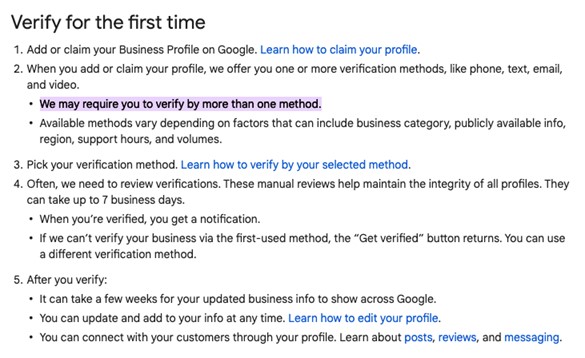
It looks like Google rolled out this update, apart from pushing for video verification, to hopefully tackle one of the persisting problems – fake locations on Google Maps.
Check out this video to better understand the steps to getting your business verified on Google.
Final Takeaway
There’s really no way you can build a strong online presence without getting your business verified on the search engine giant. Click here for more information on Google Business Profile verification and all the options available to you.
Google has now allowed all U.S. auto advertisers to advertise their vehicles on its page. Customers shopping for vehicles online will now be able to see vehicle details such as make, model, price, mileage, and advertiser name. The latest format of the advertisement is given below. When a customer clicks on the ad, it directs the customer to the vehicle description page.

Advantages Of Vehicle Ads:
- Vehicle ads are designed to help you reach your potential customers easily.
- Advertisers can now optimize their site accordingly to get a good conversion rate (both online and offline).
- Users will only see the most relevant listings from your inventory, helping you get qualified leads.
What You Need To Know:
- Both new & used vehicles can be advertised
- Only non-commercial vehicles can be advertised
- Only available for U.S. auto advertisers
How To Get Started
Are you getting the best return out of your digital marketing?
Need an extra pair of eyes to review your online game plan? Let our experts take a look at your current state and do a comprehensive
digital marketing analysis at no cost to you. Please call us at
(800) 379-2829 or
contact us today and we will get to work right away.




Want to become an expert on how to use SEO when designing your website? Read on to discover top 12 guidelines for SEO-friendly website design.
- MAKE SURE YOUR SITE NAVIGATION IS SEARCH ENGINE FRIENDLY
Using Flash for navigation on your website can be bad news if you aren’t aware of how to make Flash objects accessible and web-crawler-friendly. Search engines have a really tough time crawling a website that uses Flash. CSS and unobtrusive JavaScript can provide almost any of the fancy effects you are looking for without sacrificing your search engine rankings.
- PLACE SCRIPTS OUTSIDE OF THE HTML DOCUMENT
When you are coding your website, make sure you externalize JavaScript and CSS. Search engines view a website through what’s contained in the HTML document. JavaScript and CSS, if not externalized, can add several additional lines of code in your HTML documents that, in most cases, will be ahead of the actual content and might make crawling them slower. Search engines like to get to the content of a website as quickly as possible.
- USE CONTENT THAT SEARCH ENGINE SPIDERS CAN READ
Content is the life force of a website, and it is what the search engines feed on. When designing a website, makes sure you take into account good structure for content (headings, paragraphs, and links). Sites with very little content tend to struggle in the search results and, in most cases, this can be avoided if there is proper planning in the design stages.
- DESIGN YOUR URLS FOR SEARCH FRIENDLINESS
Search friendly URLs are not URLs that are hard to crawl, such as query strings. The best URLs contain keywords that help describe the content of the page. For example, think about the following URLs for an HVAC website:
hvacompany.com/services/repairs/
hvacompany.com/services/residential-repairs/
hvacompany.com/services/commercial-repairs/
- BLOCK PAGES YOU DON’T WANT SEARCH ENGINES INDEX
There could be pages on your site that you don’t want search engines to index. These pages could be pages that add no value to your content, such as server-side scripts. These web pages could even be pages you are using to test your designs as you are building the new website. Don’t expose these web pages to web robots. You could run into duplicate content issues with search engines as well as dilute your real content’s density, and these things could have a negative effect on your website’s search positions.
- DON’T NEGLECT IMAGE ALT ATTRIBUTES
Make sure that all of your image alt attributes are descriptive. Search engines will read alt attributes and may take them into consideration when determining the relevancy of the page to the keywords a searcher queries.
- UPDATE PAGES WITH FRESH CONTENT
If your website has a blog, you may want to consider making room for some excerpts of the latest posts to be placed on all of your web pages. Search engines love to see content of web pages changing from time to time as it indicates that the site is still alive and well. With changing content, comes greater crawling frequency by search engines as well.
- USE UNIQUE META DATA
Page titles and descriptions should all be different. Many times, web designers will create a template for a website and forget to change out the meta data, and what ends up happening is that several pages will use the original placeholder information. The Best Web Design Companies know that every page should have its own set of meta data; it is just one of the things that helps search engines get a better grasp of how the structure of the website is constructed.
- USE HEADING TAGS PROPERLY
Make good use of heading tags in your web page content; they provide search engines with information on the structure of the HTML document, and they often place higher value on these tags relative to other text on the web page.
- INCREASE INTERNAL LINKING ON YOUR WEBSITE
Internal linking can boost the rankings of your website when used correctly. It helps Google understand your content better and also sets an informational hierarchy for your website. Websites with information are consistently correlated with each other. It is very helpful for people and search engine bots when relevant information leads them to further information on the subject.
- MAKE YOUR WEBSITE MOBILE-FRIENDLY
Whenever a query is entered in the search bar, Google will rank websites based on several different factors, but mobile-friendliness is be one of the primary factors. Thus, Google requires webmasters and businesses to create a mobile friendly website.
- IMPROVE YOUR PAGE SPEED
Nobody has the patience to tolerate a loading website nowadays. With so many options available at our fingertips, people swiftly switch from one site to another to look for the desired products or services. Thus, you’ll lose the potential rankings and leads if your site’s speed is low.
Need help with website design? Get in touch with our team for expert advice.
Website redesign is complicated. Here are some steps to take away before, during, and post-launch to avoid an SEO disaster when redesigning your site.
- Take inventory of your current site
Before changing anything, you need to take a snapshot of what your site and ranks look like currently. This will be a necessary reference point post-launch when evaluating if everything is indexing and ranking as it should.
Some areas to keep in mind while taking inventory of your site are:
- Current SEO rank: Check the current rankings of each of your website and also make note of the pages that currently rank in Google.
- Crawl your current site: This will let you see what your current site looks like and grab the structure, current URLs, meta description, and titles tags so you can match your new site up to the old.
- Blocked content: Verify any blocked content with your Robots.txt and/or Google Search Console. It is good to check this list so that you can make sure that these blocked pages continue to be blocked after the redesign.
- Keep content as close to the same as possible
We all know the saying, “If it ain’t broke, don’t fix it,” but that doesn’t mean you can’t change a page.
You just need to make sure your development and copy teams know when and what tags need to stay the same. Yes, during a redesign, you may need to make some changes to copy/content, but make sure the changes are small and deliberate.
In order to maintain your current rank, you should aim to keep the title tag, meta description, URL, and the H1 – H6 the same.
These areas are the most commonly crawled and are most important for pages that already rank on Google.
- Preserve some of the overall site architecture
Yes, some of the ways you organize your navigation and files may change based on your new website strategy and goals, but if possible, try to keep as much of the structure the same as you can.
Search engines already know your current site architecture, so by maintaining it, you give yourself a better chance of not affecting your rank.
Keep your existing visitors in mind as well, you don’t want to change your structure and confuse your existing audience when they revisit your website.
- Create 301 redirects
You also want to make sure you don’t want to remove any pages that are doing well. If you must, make sure you inform the search engines about this change by setting up a 301 redirect. If you don’t implement these 301 redirects you can drastically kill your traffic
Keeping an organized list of old page URLs vs new page URLs is extremely important and will help you with re-organizing the website.
- Block your new site from search engines during staging
Once you have a game plan of what your new site architecture is going to look like, it’s time to design and get the new site built.
Make sure your development team sets up the new site on a staging environment or a platform meant for testing that resembles the live environment without launching the pages.
It is important to have a staging environment so that you aren’t messing around with your live site and prematurely set pages live and having search engines index duplicate content.
A very IMPORTANT thing to do once your staging environment is set up and put a “No Index, No Follow” on it.
You don’t want Google finding your staging environment and marking it as duplicate content. This will create a bigger mess to clean up once you take your new site live.
- Double check everything in staging
When everything is built, run tests on the staging environment to make sure you aren’t missing or have duplicate H1 & H2 tags, title tags, and meta descriptions.
Once everything looks good and you have not only run some SEO tests but also did internal QA (Quality Assurance) to make sure the site is responsive and works in various browsers, it is time to take the site live.
What about post launch?
Even everything looks great in staging, once you set a site live, there are several things you need to do to ensure you maintain your SEO.
Here is a quick hit list:
- Remove “No Index, No Follow” – This is a very easy thing to forget to do it is the #1 item on our post-launch checklist when launching a site to make sure that is removed.
- Import your 301 redirects
- Check your 301 redirects to make sure if you did redo your highest-ranking pages that they are redirecting where they should go
- Make schema.org tags are still implemented
- Make sure tracking codes are all still up and running
- Re-run broken link checker
- Re-submit new submit to Google Search Console
You should be monitoring your new site regularly to spot any issues. Check Google Search Console to check on the number of pages indexed in Google to ensure no pages dropped, track impressions and clicks, and track your rankings.
It’s important to monitor these things so that if you did drop in SEO rank you can work on getting it back up quickly, rather than catching it too late.
Need help? Do get in touch with our professionals for assistance.
Instagram will open product tagging to every user in the U.S. The ability to tag products is starting to roll out now and will become available to everyone within the next few months.
Product tagging debuted on the platform in 2016 as its initial foray into e-commerce. Until now, only businesses and creators could tag products in video posts, stories and reels.
Of its 2 billion monthly active users, Instagram has an estimated 159 million users in the U.S., according to Statistia.
Why we care.
Instagram said that 1.6 million people are already tagging at least one product per week. By making product tagging available to everyone in the U.S., this number will likely skyrocket as users learn of and use this feature. This is yet another way for brands and businesses to be discovered organically on Instagram. So if your brand isn’t set up for Instagram Shopping, there’s no better time than now to test it.
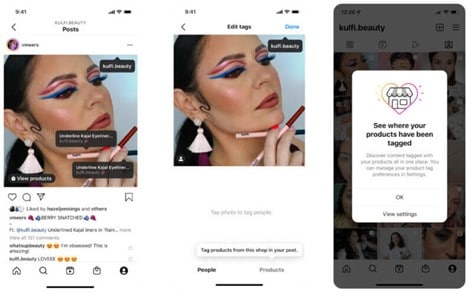
How to tag products?
After creating a post, users would tap the “Tag Products,” tap the product in the video or image, then search for the product from the shop to add a tag. Instagram users who see a product tag can tap it to buy the product within the app.
Control for brands and businesses
Whenever one of your products is tagged, Instagram will notify you on your profile. Want to turn off product tags? You can in your account settings. By default, it is set to “Allow all”.
Are you getting the best return out of your digital marketing?
Need an extra pair of eyes to review your online game plan? Let our experts take a look at your current state and do a comprehensive
digital marketing analysis at no cost to you. Please call us at
(800) 379-2829 or
contact us today and we will get to work right away.


Last month Google released a new API for Search Console — the URL Inspection API. Now you have a developer tool that can debug and optimize your web pages. Isn’t that great!
While launching this tool, Google said, “Today we’re launching the new Google Search Console URL Inspection API, which gives programmatic access to URL-level data for properties you manage in Search Console.
The Search Console APIs are a way to access data outside of Search Console, through external applications and products. Developers and SEO tools already use the APIs to build custom solutions to view, add, or remove properties and sitemaps, and to run advanced queries on Search performance data.
With the new URL Inspection API, we’re providing a new tool for developers to debug and optimize their pages. You can request the data Search Console has about the indexed version of a URL; the API will return the indexed information currently available in the URL Inspection tool.”
How the new API works:
You need to make an API call. The request parameters include the URL you’d like to inspect and the URL of the property as defined in Search Console. Once you make the API call, you will get a response with all relevant results or an error message if the request fails.
Here’s an example of the response you’ll get from the API.
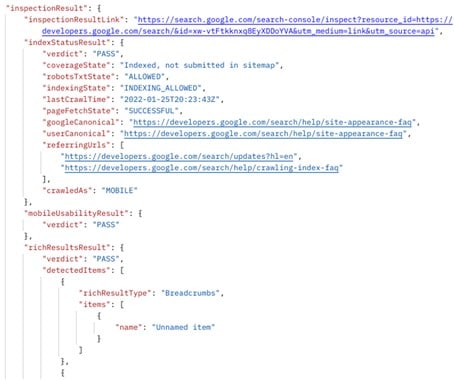
There is a usage limit to Search Console APIs. Specifically, with regards to the URL Inspection API, the quota is enforced per Search Console website property. Queries are limited to:
- 2,000 queries per day
- 600 queries per minute
The new API looks useful and could potentially be added to CMS platforms and SEO toolsets shortly.
Google recently launched “Shops” to help customers with their shopping-related queries. The initial search result shows only three shops, but users can expand the results to view more merchants. The results are based on organic search ranking.
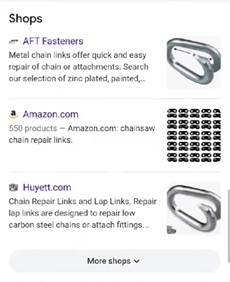
Google recently launched “Shops” to help customers with their shopping-related queries. The initial search result shows only three shops, but users can expand the results to view more merchants. The results are based on organic search ranking.
Google has further enhanced its shopping-related results by including the unpaid, organic listings, introducing a “Deals” section, and other such significant integration. These updates are important to the retailers because their businesses now stand a chance to attract more customers and drive traffic.
Points to Remember
- Try to rank well in the organic SERPs by optimizing your site.
- Focus on Google’s other Shopping Channels to gain better visibility.
URL Changes for Google Search Can Take a Long Time
Google’s Search Advocate, John Mueller, revealed that changes to a site’s URL structure is not so easy for search engines. Google recently put out a short, 2-minute video explaining the kind of SEO impact you should brace for if and when you decide to change your site’s URL structure. Turns out that the entire process could take months…when done properly!
Here’s the video released by Google: https://youtu.be/FHjVmi1tkEw
What Makes the Process Not So Simple
As per Google, each URL is stored as an address in the search engine’s index on a per-page basis. When you change the URL structure, all the data for the original URL, including signals, links and other important information that Google has on that page, needs to be forwarded to the new URL.
Things to Bear in Mind When Considering URL Changes
- Google’s Site Move Documentation
As the URL change process can be quite complicated, Google has taken efforts to detail site move documentation. Muller has summarized the key points from the site move documentation.
- Do your research before initiating the migration.
- Go for the update when you can afford to have a dip in your site traffic.
- List down all the old and new URLs for mapping purposes.
- Make use of 301 redirects and internal site updates, such as navigation and XML sitemaps, to implement the migration.
- Keep a close eye on the migration through analytics and Google Search Console.
- The Timing of the Migration
Google states that while completing the URL change process can take months, the search engine will process the “more important” pages faster. On the other hand, the less important URLs will require more time to be processed.
Google recommends that the redirects used during migration, the 301 redirects, are left in place for at least a year.
Final Takeaway
SEOs, site owners, webmasters and publishers know just how scary URL changes can be. Hence, going about it the right way with the right tools in place to monitor the progress and catch any errors along the way can do a great deal to reduce your stress.
Are you getting the best return out of your digital marketing?
Need an extra pair of eyes to review your online game plan? Let our experts take a look at your current state and do a comprehensive
digital marketing analysis at no cost to you. Please call us at
(800) 379-2829 or
contact us today and we will get to work right away.





We have been busy working on our platform and updating our technology and have some good news to share. Here are few of the important updates we wanted to share:
-
- Late last year we realized that search engines like Bing were getting more aggressive in banning bots. This affected our keyword ranking (SERP tracking) module. We did some brainstorming and came up with the idea that in order to get the most accurate results we would have our technology to replicate actual human visitor behavior. It’s with great pleasure and excitement we are announcing this new SERP tracking technology for Bing keyword tracking. We hope to slowly use this technology for Google rankings, audits, and other key areas to future proof our results.
-
- Not only regular search results, but we will prioritize tracking of other important sections in Bing SERP that includes “People Also Ask” results, Video and Image search results and show them on our dashboard.


-
- One of the most requested features by agencies – Apart from Local Map pack in Google SERPs, we are moving one step further to track local rankings by detecting your client’s website presence in Google Maps results.

-
- Keyword opportunities are always a great KPI you can show your clients. We will be introducing a new section to show “suggested search keywords” for each keyword we are tracking. This offers additional keywords we can target and rank – thereby increasing traffic to the website.
-
- Tracking multiple business names for a business is difficult. So far, our system could track rankings for only a single business name. We will improve this system to track more than one name for a particular business. This gives a chance to show more keywords that are ranking for a business.
-
- Scan your client’s website health for 100+ harmful issues with our much-improved high speed SEO crawler. Our advanced crawler will identify issues on the website that might be limiting its rankings. This should help to make your client’s website more search friendly, thereby improving rankings.
-
- Crawler audit data will also be introduced on a “Per Page” basis giving accurate information about a particular page in addition to the whole website (global level). This gives a chance to resolve SEO errors at a minute level.
-
- Our website monitoring system is getting an overhaul with more accurate information. Our improved and reliable website uptime/downtime monitoring system will instantly alert you via email if the website goes down.
If you have any request for new features to be added or improvements in existing modules, please feel free to reach out to us.
Google My Business, which has been rechristened as Google Business Profile, now has a new feature that will allow businesses to mark a product as “Special”. This feature, which has been rolled out by Google recently, appears in the products section and takes the product marked as special right to the top of the products listed in a business’s Google Business Profile Listing.
Here’s a look at what the product section now looks like:

The Google Business Profile products section setting displays the option to “Mark as Special”. It clearly states that “Products marked Special are shown at the top of the page.”
What makes this an exciting development
While not all businesses may see the need for this feature, a section of local SEOs and businesses have been looking for a way to promote certain products at the top of the page. This feature gives them the ability to put the best of their products high up in their Google local search and Maps listings.
A query was raised by the user regarding Search Console reports. The user stated they are having a problem with some of their web pages showing up and then dropping out of Search Console reports. Especially in regards to the Core Web Vitals report, they are seeing a steady decline in the number of pages reported from month to month.
Google’s John Mueller recently addressed this issue in an office hours segment where he said, “it’s a matter of how Search Console reports on web pages. Rather than attempt to include every page in the report, they use a sample of the URLs from your site. The number of pages they use to sample your site can vary from month to month in exactly the way that you’re reporting.”
He further added, “it’s something where having fewer URLs in these reports doesn’t mean that the other URLs are bad or problematic. It’s just we didn’t check them.
So especially for the aggregate reports, which is for the Core Web Vitals to some extent, the AMP report, the Structured Data report, mobile friendliness … for those reports, we only take a look at a sample … and that sample can change over time.”
He explains, “they might look at 200 URLs in one month and then in the next, they’ll look at maybe 100 URLs or something like that. It doesn’t mean that anything bad is happening; it’s just that Google is looking at a smaller sample of pages from your site.”
He advises that instead of stressing out about the changing sample size you should focus on what is actually being reported – specifically the relationship between the bad pages that are reported and the good ones.
If you see that all of the URLs in the report are without errors, then you’re good to go. But if you’re seeing errors, and especially if the proportion of errors is increasing over time, then you’ve probably got some fixing to do.
In any case, the total number of URLs in the report should not be your primary concern. It’s the relationship between the pages and the reported negatives that you should focus on and attempt to fix.
You can watch this video here, where John discusses the issue starting at the 51:33 mark:
https://youtu.be/rCcDsmjn-SA
Are you getting the best return out of your digital marketing?
Need an extra pair of eyes to review your online game plan? Let our experts take a look at your current state and do a comprehensive
digital marketing analysis at no cost to you. Please call us at
(800) 379-2829 or
contact us today and we will get to work right away.



SEO (Search Engine Optimization) can help you increase the visibility of your website when your target audience is searching for services or products related to your business. The process involves optimizing your website and content as well as staying well-informed about your competitors.
Reasons to design an SEO-friendly website…
a) Greatly improve customer experience
Good customer experience ensures that they will return to your site the next time. Also, the more time the customers spend on your site, the higher your rankings are.
b) Gain the favor of web crawlers
SEO helps you to update your site according to the latest search engine requirements, enhancing your rankings significantly.
c) Increase customer engagement
An effective SEO strategy can help you attract more customers and ensure that they spend more time on your site. This step is very important to improve your rankings.
d) Achieve a higher ranking
You must work on your website content, site design, and SEO strategy to rank higher. Higher rankings ensure that you have better sales and that you stay on par with your competitors.
e) Excellent returns
SEO activities are known to deliver the best return on investment. When you achieve a higher ranking and relevant site traffic, you can easily get the desired returns.
Points to consider while designing an SEO-friendly website.
a) Easier website navigation
Buyers prefer a website that has relevant, organized information. Don’t forget to incorporate a sitemap page so that users can easily find and visit the required link.
b) Select an SEO-friendly domain
Your domain name should have keywords related to your services or products. This helps your target customers to find your business easily. Also, the domain name should be unique yet relevant to your industry.
c) Optimal & easy-to-understand content
Your website content can affect its loading speed. It is important to keep your website light to ensure an excellent user experience.
d) Mobile-friendly site
Many people access various websites through their mobile. A mobile-responsive website ensures that your target customers can reach out to you via various gadgets.
e) Reach out through social media
Social media can help you drive traffic to your site, improve your online presence, and increase sales.
f) Add captions to your images & videos
Adding captions ensures that website crawlers can find your content. Insert appropriate keywords in your captions so that people can find the content easily.
g) Update your content
Creating new content is a must to increase the rankings of your pages. The best way is to remove old, low-ranking articles and add new, fresh information to attract new audiences.
h) Include internal and external links in your strategy
-
- Internal links can help a visitor to navigate your website easily. It aims to introduce other web pages of your site to visitors.
- When external links direct users to your website, search engines consider your site reliable and trusted.
- Link building does take time, but it can significantly boost your traffic.
Web design mistakes to avoid…
a) Repetitive heading tags
Adding appropriate & unique headers (H1 and H2 tags) at the right locations can help improve your rankings. Also, adding necessary keywords is a must.
b) Non-responsive website design
If your website is not mobile-friendly, you may lose a lot of customers. If your site is not compatible with mobile phones, you should get this issue fixed as soon as possible.
c) High-resolution images
Large size images can affect the loading speed of your website. The best way to upload images is to compress and resize them. Use Google PageSpeed Insights tools to check the loading speed of your pages.
d) Too short content
To optimize the page loading speed, many designers do not add much content to the site, forgetting that it is equally important to add good, informative content to your site.
e) Adding the infinite scrolling feature
It is one of the effective ways to hold your users on your site for a longer time. Splitting the content of a website can make it easier for web crawlers to crawl them.
Lastly…
Whether you are creating a new website or improving a current one, keep the target audience and search engine algorithm in mind. Talk to your SEO experts and follow the above guidelines to improve your rankings. If you need help, we are just a call away.
To come up with a successful marketing campaign, advertisers need to understand post-click user behavior and engagement on landing pages. This is precisely why Microsoft Advertising took it upon itself to introduce a new tool last month – Microsoft Clarity Insights!
An overview of the key benefits of this tool
- More Powerful Data – It helps you to understand the customer journey and enhance the signals to make optimization decisions on your website and advertising campaigns.
- Free Website Analytics – It enables you to gain a deeper understanding of user behavior, path to conversion, and engagement on the landing pages.
-
- Use Sessions Recordings to replay user sessions and better understand the customer journey
- Through Instant Heatmaps decode engagement on ad landing pages, including clicks, scrolls, and movement
- Make the most of the powerful Analysis Dashboard to analyze engagement by campaigns, channels, and browsers
- Seamless UET (Universal Event Tracking) Upgrade – Sign up using your existing MS Advertising credentials and your existing JavaScript UET tags will be updated on the back end.
Several companies have harnessed the power of Clarity Insights to:
- Increase the average time their customers spend on their blog
- Significantly improve their click-through rates
- Reveal any usability issues that they may be facing
- Provide insights into the average scroll depth of their blog readers
- Detect interesting user behavior patterns
- Boost their conversion rates
- Figure out the drop-offs and abandonments
Final takeaway
To get started with Microsoft Clarity Insights, you will have to reach out to your Microsoft account manager. However, it is important that you first ensure that your JavaScript UET tags are up to date. Ideally, you should place the tag across your website to attain all kinds of information on user behavior.
From November 2021, UET tag creation will be compatible with Clarity Insights by default. By mid-November, Microsoft will migrate all existing UET tags to include Clarity Insights, except websites that contain sensitive data. Once the UET tag has been updated, accessing Clarity through the MS Advertising account should be possible.
To learn more about the data collected through this tool, visit the following links:
We also recommend you go see a FREE live demo before signing up for this tool! If you have any questions, we are here to assist you.
On 28th Oct 2021, Mark Zuckerberg announced that Facebook is renaming itself to “Meta” to encompass its expanding technology and role in what it calls “the metaverse.” Facebook owns apps such as WhatsApp, Instagram, Oculus VR, and more. In July this year, Zuckerberg told The Verge that over the coming years Meta would “effectively transition from people seeing us as primarily being a social media company to being a metaverse company.”
So what’s the Metaverse?
Mark Zuckerberg explains in his founder’s letter: “You will be able to teleport instantly as a hologram to be at the office without a commute, at a concert with friends, or in your parent’s living room to catch up.”
“Our hope is that within the next decade, the metaverse will reach a billion people, host hundreds of billions of dollars of digital commerce, and support jobs for millions of creators and developers,”
He gave marketers a clue about the opportunities that lie ahead and how the company is invested in them. It is said that the company will spend $10 billion over the next year on technologies needed for building its metaverse.
The announcement said, “Starting with our results for the fourth quarter of 2021, we plan to report on two operating segments: Family of Apps and Reality Labs.”
“We also intend to start trading under the new stock ticker we have reserved, MVRS, on December 1. Today’s announcement does not affect how we use or share data.”
Controversy Post Rebranding
Post the rebrand, whistleblower Frances Haugen’s revelations have Facebook under fire for its practices, morals, and social impact.
Zuckerberg pointed out in his founder’s letter that Meta’s metaverse may offer exciting avenues, especially for the digital industry.
Facebook is already a destination to discover local businesses. But, from a branding standpoint, we simply can’t look away from a branding fail, and “Meta” just feels like one.
Are you getting the best return out of your digital marketing?
Need an extra pair of eyes to review your online game plan? Let our experts take a look at your current state and do a comprehensive
digital marketing analysis at no cost to you. Please call us at
(800) 379-2829 or
contact us today and we will get to work right away.



Google’s new system for generating titles – “Titlepocalypse”, which was supposed to generate titles for about 20% of the web pages in the search results, was not very well received. Many were of the opinion that the search engine giant rushed to roll out a system that they had not yet thoroughly tested.
Taking into consideration all the user feedback they received, Google revised the update to rewrite and generate HTML titles for just around 13% of the time. Furthermore, they provided an explanation on what triggers the system to rewrite a title tag.
So what leads to a title tag rewrite?
In a document titled, ‘More information on how Google generates titles for web page results‘, Google helps creators understand what exactly they look for in a title hence Titlepocalypse.
They explained that title elements are used most of the time. Google’s new system is said to use the HTML title element as the title shown in the search results for around 87% of the time. Since 2012, Google has had to use text other than title elements when their system determined that the present title failed to describe a page very well. Mostly, the web pages that fell into this category were those with empty title tags, duplicate titles regardless of the content on page and pages with no title elements whatsoever.
The document also listed examples of when the system went beyond the title elements. The new system is designed to address certain situations where going beyond the title element may be more helpful for the web pages. Some of the situations listed are as follows:
-
-
Pages with Half-Empty Titles
Half-empty titles are titles wherein the site name may be present, but it may be missing the summary of the page. This situation generally occurs when templates are used to create titles. These tiles usually look somewhat like this:
| Site Name
The system detects such titles and tries to make adjustments based on the header elements or any other prominent text it can find on the page, such as:
Product Name | Site Name
-
-
Pages with Obsolete Titles
Obsolete titles occur when the same page is used every year but the title element fails to reflect the latest date. For instance:
2020 admissions criteria – University of Awesome
If the headline on this page reads “2021 admissions criteria”, the system will go ahead and change its title to:
2021 admissions criteria – University of Awesome
-
-
Pages with Inaccurate Titles
If Google detects that a web page’s title is not properly describing the content on the page, it will consider the title to be inaccurate. An example would be a page with dynamic content and a title that reads:
Giant stuffed animals, teddy bears, polar bears – Site Name
Google may then take it upon itself to change the title to something along the lines of:
Stuffed animals – Site Name
-
-
Pages with Micro-boilerplate Titles
A micro-boilerplate title is that one title which is used for a number of pages within a site, such as those used for television shows that may have several seasons but the season numbers are omitted from the titles. An example of such titles would be:
1: My so-called amazing TV show
2: My so-called amazing TV show
3: My so-called amazing TV show
The system may modify these titles to display the season numbers mentioned in the headline text so that it becomes a little easy to identify which page is for which season.
Season 1 – My so-called amazing TV show
Season 2 – My so-called amazing TV show
Season 3 – My so-called amazing TV show
Final Takeaway
We have to give it to Google for acknowledging that the system they have in place for creating titles is not perfect. Moreover, they welcome the creators to provide their feedback.
Also, it may help to review and follow the SEO guide provided by Google on their help page on creating good titles and snippets in search results. After all, Google uses the HTML title elements to determine the ranking 100% of the time!
Remember
- Title tags are considered for rankings even now.
- Continue to focus on creating great title tags with focus on target keywords.
- Include H1 and H2 in your page content including your target keywords.
Wish to improve the search visibility of your eCommerce site? Google Search Central has released new SEO guidelines for developers. In this article, we will brief you with the steps you must follow and also attach the reference links so that you can make a better plan.
Google states that –
Your content shows up in Google Search & other Google surfaces only when Google can find and parse your eCommerce data and site structure. Your site and products will then be visible to the shoppers.
All the eCommerce’s SEO Guide–
-
-
Understand Google Surfaces
Google has many surfaces where your content can be displayed. Understanding every surface can help you reach new potential customers. Check out the article from Google to learn more.
-
-
Provide product data to Google
Sharing your eCommerce product data with Google can help you get more traffic to your site. Wish to know more? Visit this link – Share your product data with Google.
-
-
Google appreciates structured data!
When you add structured data to your websites, Google’s accuracy to understand your content is highly enhanced. For more details, visit Google Search Central now.
-
-
Steps to launch a new eCommerce site
If you are planning to launch a new eCommerce site, Google suggests you follow certain steps so that your site is recognized & crawled by Google.
-
-
Well-designed URLs can help…
A well-developed URL structure can help Google to locate your web pages. Are you building your site? Check out the SEO guide from Google to avoid indexing issues.
-
-
Navigation structures can impact Google’s understanding!
The navigation structure on your site helps Google to determine the importance of a webpage. To learn how you can assist Google, check out Google Search Central’s Blog now.
-
-
Display a subset of a larger list
To improve page performance, Google suggests displaying a subset of results. Also, ensure that Google crawlers can find your site’s content. Read more about the UX patterns to get started.
We encourage you to check out the links in this article and discuss with your SEO experts to implement the SEO guide and guidelines. If you need help with your ecommerce website, please get in touch with us.
Google’s John Mueller has discussed the impact of WordPress Themes Logo on SEO. According to him, rankings are affected when one changes the theme of a WordPress website. The various details that the website themes can determine are as follows:
-
- Content display
- Internal links
- Page load time
- Content options
- Structured data use
John further added that you should try various themes on a test website before finalizing one of them. You can also add some content from your site and note the details while keeping the above points in mind.
John also recommends that you follow some additional steps, such as:
Factors that can affect page speed load times:
-
- Faulty coding & un-optimized CSS, javascript.
- Need for multiple plugins.
- Excessive loading of internal or external resources.
Final takeaway
You can always take certain steps to ensure that your WordPress themes do not affect your ranking, such as:
-
- Select your website theme wisely.
- Faster load times should be your main goal.
- Some themes claim they are SEO-friendly, but still, test them.
- Prefer using Gutenberg-based editors (aka, Gutenberg blocks builders).
- Remember to block the indexing of your test website.
Are you getting the best return out of your digital marketing?
Need an extra pair of eyes to review your online game plan? Let our experts take a look at your current state and do a comprehensive
digital marketing analysis at no cost to you. Please call us at
(800) 379-2829 or
contact us today and we will get to work right away.





On August 17, 2021, many people noticed Google using header tags (H1s & H2s) rather than meta title tags as titles. A number of people posted their questions and complaints related to this change on various forums and social media platforms.
Below are some of the public mentions & the answers from Google and other SEO professionals.

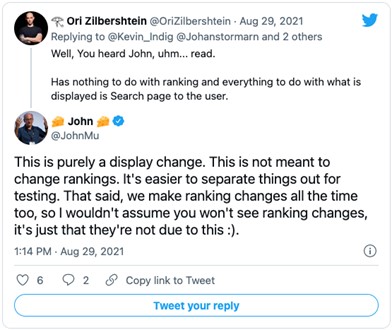
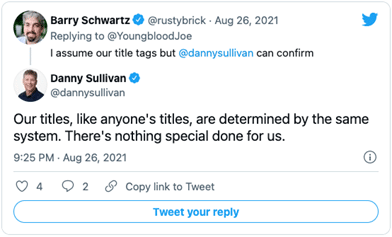
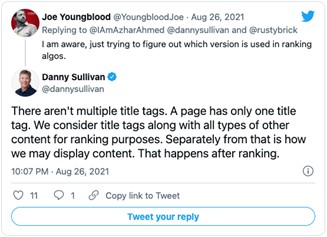
From the above posts, we can confirm that your rankings are definitely not affected by this update (at least for now)!! Its only purpose is to make your titles more readable and precisely describe your document’s content. This new system is preferred by the users, as they can connect with the page content easily.
Many people wanted Google to explain more about this update, so there were many comments related to this topic. Google’s staff answered their queries in this official post.
Points To Remember:
- Title tags are considered for rankings even now.
- Continue to focus on creating great title tags with focus on target keywords.
- Include H1 and H2 in your page content including your target keywords.
Analyze your site?

Google recently announced that the link spam update is complete. The update that initially began rolling out on July 26th, 2021, is now done rolling out as of August 24th, 2021. It took over a full month for this update to roll out and two weeks longer than Google had said.
Here’s Google’s announcement about the link spam update that is done rolling out.
Earlier, Google said, “This algorithm update, which will roll out across the next two weeks, is even more effective at identifying and nullifying link spam more broadly, across multiple languages.”
The update is finally fully live.
So how do you know if your site has been impacted by the update? Tough to say as of now! We had a bunch of unconfirmed updates after this announcement was made. Maybe they were related to the link spam update, maybe not.
All we know is that the Google link spam update didn’t have any negative effect on our client rankings.
If you’ve been affected by this update, you can get in touch with our team for professional help.
See How Here!
All You Need To Know About This New Feature!
- The Shop Tab of Instagram will now include ads.
- This feature is still under test in the U.S.
- Ads can either be a single photo or multiple photos.
- Only a few retailers such as Away, Boo Oh, Clare Paint, DEUX, Donni Davy, Fenty Beauty, and JNJ Gifts could participate in this test.
- An auction-based model will be used to launch Ads in Instagram Shop.
- The Instagram Shop tab is a mobile-only feature, so the ads will only appear on mobile.
- How many ads a single consumer sees will be determined by several factors, such as:
- Instagram, how do they use it?
- And, how many people are shopping in the tab?
- Instagram also plans to monitor consumer sentiment to balance ads and content.
Why This Feature Is Important
If this feature is approved, many retailers will be able to reach their target customers easily. Also, cross-app tracking and third-party cookies will not be an issue anymore.
Final Takeaway
There are no details available yet as to when other retailers would be able to join in. However, it is clear that this feature will surely be made available globally in the coming future.
For more information, check out this article.
Are you getting the best return out of your digital marketing?
Need an extra pair of eyes to review your online game plan?
Let our experts take a look at your current state and do a comprehensive digital marketing analysis at no cost to you.
Please call us at (800) 379-2829 or contact us today and we will get to work right away.



Google recently said that the new algorithm update for Google search “is even more effective at identifying and nullifying link spam more broadly, across multiple languages.” Named the link spam update, it started from July 26th.
Also, Google posted this lengthy blog post named “A reminder on qualifying links and our link spam update.” The blog post is a reminder of the type of links that work against Google’s webmaster guidelines.
The Google blog post concluded by announcing the link spam update:
“In our continued efforts to improve the quality of the search results, we’re launching a new link spam-fighting change today — which we call the “link spam update.” This algorithm update, which will roll out across the next two weeks, is even more effective at identifying and nullifying link spam more broadly, across multiple languages. Sites taking part in link spam will see changes in Search as those links are re-assessed by our algorithms.”
Key Takeaways From The Link Spam Update
- The name of the update is Link Spam Update and not Link Spam Update July 2021.
- Google used the word “nullifying,” which does not necessarily mean “penalize,” but to ignore or not count spammy links.
- It is a global and multilingual update.
- Google did not post anything about how much this will impact the search results.
So if you notice a drop in your rankings over the coming weeks, it could be due to this update.
We did a deep analysis of our client’s websites to check if this update affected our rankings and we’re happy to say that there has been no major ranking drop as far as our clients are concerned. Our campaigns continue to enjoy stable rankings that we’ve achieved through ethical SEO methods. However, we will continue to keep an eye on the rankings as it is a global update and will inform you of any major changes in results.
Analyze your site?
Do you wish to know about the latest core update from Google? If yes, then this article is a must-read for you. Here, we will brief you about this update so you can make well-informed decisions about your website.
Quick facts about this update:
- On July 12th Google announced that the core update rollout was complete. Below is the official post:

- This update is not specific to any language, region, or website category.
- The main aim of any update is to provide better or improved search results. If you are a site owner, read this article related to Google’s core updates.
- Due to the pandemic, there is a significant shift in users’ search behavior. Google is striving hard to understand this behavior to show relevant results.
- A lot of websites are experiencing huge changes in their organic ranking positions.
- Various industries, such as Beauty & Fitness, Real Estate, Shopping, Health, Pets & Animals, & Travel & Tourism, saw the steepest increase in rank volatility.
- Industries such as Arts & Entertainment, Finance, Games, Sports, Jobs & Education, Food & Drink, and News industries saw the least dramatic increase in rank volatility.What you can do:
- Try fixing your site according to Google’s guidelines.
- Focus on quality content & include content that is helpful to users.
- Write your content with search engines and users in mind.
- Fix or avoid any SEO mistakes.
Read the guidelines and follow the above steps to tackle any changes that this update has brought to your site. If you need help, we’re just a call away!
See How You Can Improve Your SEO!
You must have received a ton of SEO advice from all kinds of sources. While some of them sound cool and trendy, they do absolutely nothing for your business. On the other hand, some SEO tactics actually do work, but they take a long time to deliver expected results. Hence, we bring to you 101 proven, actionable SEO tips that will get you results in real-time.
Basic SEO
- Videos are highly effective! Do not shy away from using and optimizing them.
- Make sure you pay close attention to user intent search queries when you are conducting keyword research.
- Work on building authority & trust. Start creating original content that clearly signifies your expertise and business goals.
- Create user-friendly content. Learn about the latest user trends and human behaviour before creating content.
- Get those customer reviews! Build a strategy wherein your customers can provide their reviews or feedback easily.
- It is best to bring in an SEO professional right from the beginning, so that the web design, especially the mobile version, is SEO-friendly.
- Strive to meet client expectations. Not being able to meet their expectations may cost your business its credibility.
- Using ‘exact match’ keywords isn’t necessary as Google is quite capable of associating topical keyword search terms.
- You may want to try personalizing your call to actions based on a referral, location, or keyword search query.
- Keep the domain name short. Make sure the one you choose contains less than 15 characters so that it’s easy to remember for the users.
- Remember to look for all variations of your site in the search engine. For example:
- http://xyz.com
- http://www.xyz.com
- https://xyz.com
- https://www.xyz.com
Mobile SEO
- Mobile-first is the way to go. With Google switching to mobile-first indexing, it is wise to check how the search engine ranks your mobile site using the Mobile-Friendly Test Tool in Google Search Console (GSC).
- See if AMP & PWA work for you. If you do not have a mobile site, your Accelerated Mobile Pages (AMP) or Progressive Web Apps (PWA) will be served up in the mobile-first index.
- Get rid of those pop-ups and interstitials as they can be annoying on a mobile site unless they serve as a warning for age restrictions or data privacy.
- Scroll tracking on Google AMP can be very useful and implemented easily through Google Tag Manager.
- Add forms to your AMP to attract leads.
- Consider investing in PWA. As PWAs are expected to replace 50% of consumer-facing apps, investing in them is highly recommended for B2C businesses.
- Boost your click-through rates with breadcrumbs. Creating a clear path to follow with the help of breadcrumbs will help you increase the click-through rate on your mobile site.
Technical SEO
- Migrate your site to HTTPS. While you do that, be sure not to make any additional changes, as Google may not acknowledge these changes.
- As search engines crawl even duplicate URLs, it is important to use canonical tags.
- Keep the loading speed down to 2-3 seconds. Use the Core Web Vital report along with your developer to figure out how you can improve your site loading speed.
- Aim for Google’s Top Stories Carousel. The best way to make it there is by creating AMP pages, publishing legitimate news, and submitting the site to Google News.
- Remember to Use rel=canonical tags. Any page that can be reached through different URLs should have the rel=canonical tag to avoid any confusion about duplicate content.
- Always remember to check whether your pages are indexed with ‘site:domain’ search and that none of them is double-indexed.
- Ensure that you do not use more than one H1 tag per page.
- Use Image Alt Attributes. As Google is now moving towards visual search, this is one important aspect you should not ignore.
- Creating separate sitemaps for sections like images, videos, blogs, etc. will help Google to focus its crawl.
- If your site has dynamic URLs, adjust the URL parameters in GSC.
- Remember to change all the internal links from HTTP to HTTPS before you migrate your site.
- In order to improve your user experience and SEO, always add breadcrumbs to your site.
- Avoid long redirects. By avoiding chain redirects you can help the search engines to crawl your website more quickly.
- Opt for Vector Format image files. Using vector files will allow you to have better image quality on different devices.
- Consider using a Content Delivery Network (CDN) to host your images as it helps to speed up your website considerably.
- Ensure that you optimize all your images for page speed and user-friendliness.
- When you have products with similar names and descriptions, it is better to create canonical tags instead of redirecting them.
- Opt for private hosting. While this will have no effect on your search rankings, sites having shared hosting get indexed less.
- Consider investing in visual search. Incorporating visual search in the marketing strategy can be highly effective for retailers and e-commerce businesses.
- Use Structured Data to improve ranking. While it isn’t easy for a site to get on the first page of the SERPs, using structured data can improve the chances significantly.
Link Building
- Make sure you use the disavow tool to get rid of those spammy links.
- Paid links can cost you! Google webmaster guidelines clearly state that the search engine is not in favor of paid links.
- Stay away from bad links. If Google comes across any risky link-building tactics, it could backfire big time.
- Stick to high-quality directories. Building links on high-quality directories will add relevance to your business.
- Build a clear linking structure. Plan your internal linking strategy carefully so that Google can navigate your site easily.
- Make sure your link profile is healthy. A healthy link profile helps to establish the overall quality and authority of your site.
- Focus on quality instead of quantity. Even with link building, authenticity is what matters most.
- Manual outreach can work wonders. Proactive link-building efforts allow you to control the quality of links.
- Create nofollow outbound links. In case you end up linking to a low-quality website, you can use them for external links.
- See to it that your internal links are logically placed. It is best to ensure that when you link internally, the content around the link is related to the keywords.
Content Optimization
- Don’t just focus on the keywords. Instead, create content based on important topics.
- Avoid creating thin content. As compared to thin content, long-form content can get you much better results in search rankings.
- It is important that you clean up all the scraped or duplicate content from your site.
- Revisit old content. See if any of your old content is still driving traffic and try creating new posts along similar lines with more relevant content.
- Add FAQ pages. Creating these pages will not only help your readers but also your site’s search rankings.
- Make the most of syndicated content. While you do this, ensure that the other sites place rel=canonical tags.
- Remember, content can be repurposed. It is recommended that you think of all the ways you can repurpose your content into videos, Slideshare, etc.
- Editing is a must! It is important to check all your content for errors so that nothing hampers your user experience.
- There are tools available for content ideas. Make the most of tools like BuzzSumo to get an idea about what kind of content ranks high.
- Old content may do more harm than good. Check on your old posts regularly to see if any of them is hurting your rankings.
- Do a cache check; see when a website’s pages were last cached. If it’s over a month, avoid the site.
- Try using a conversational tone when creating content. It may help your site rank for voice search queries.
- Instead of pasting the manufacturer’s content, take the time to write original product descriptions.
- Avoid keyword cannibalization. Instead of having multiple pages trying to rank for similar keywords, try combining their content to form one long-form content piece.
- Analyze your keywords. Conduct an analysis of your content to see if you can add to it and boost your page ranking.
- Try creating personalized UX. See if you can offer different pieces of content for new visitors and the returning ones.
Local SEO
- Create content focused on local facts and guides. It can help your business appear higher in search rankings.
- Take advantage of Trip Planning. Use this feature in Knowledge Graph to create local travel guides.
- Make use of the Local Inventory Ads program. It will allow your customers to browse the local store through Google.
- Try and find new, creative ways to encourage your customers to give reviews.
- Optimize for user location. You can do this by using the Google Ads distance and store visit reports.
- Optimizing for multiple locations is also very important. Make sure the NAP details are consistent for every location across all platforms.
- Add Regional Pages. If your business locations cover multiple states, regional pages are a must.
- Put up photos on your local pages. Photos of the local office give the business more credibility and make it more appealing to the local audience.
- Add ‘near me’ in your content! With the steady growth of voice search queries, optimizing for these searches has becomes all the more important.
Analytics & Tools
- Analyze your exit pages. Find out which pages the users are leaving most frequently and revise them.
- Don’t forget to add your IP address! It is important that you add your IP address to Google Analytics.
- Keep an eye out for a sudden drop in traffic. It may be due to an algorithm update or a manual action.
- Pay close attention to your competitors. Check whether their sites are ranking for the same keywords through new content.
- Try using Google Visits Conversions. If your business is eligible, you must definitely give Google Visit Conversions in Google Ads a try.
- When you first set up GSC, remember to add both the www & non-www versions of your site.
- Add your subdomains to GSC as new property so you can get all necessary data.
- Consider rewriting your meta descriptions. You may want to rewrite your meta descriptions if you see low click-through rates in your GSC Search Analytics report.
- Check out Google Analytics Segments. This particular feature allows you to gain more insight into your traffic data.
- Create custom dashboards in Google Analytics and Google Data Studio so the first thing you see when you log in is exactly what you need.
- Insights is as important as data. Before you try optimizing, gain insights into the latest trends and behaviour by using the content analytics tools.
- Answer those questions! See what questions are most commonly asked related to your keyword terms and provide the answers to them in your content.
- Add Bing Webmaster Tools to your toolkit. You will find that there are some useful tools that are not available in GSC.
Social Media SEO
- Go for Twitter Cards instead of Twitter URLs. Using Twitter Cards will allow you to make your URLs appear more clickable.
- Add Open Graph Markup. Using Facebook Open Graph Tags is one of the best ways to optimize your posts on the platform.
- Ensure your company profile on LinkedIn is complete. Complete company profiles get more views.
- Get active on Instagram. It’s high time that e-commerce businesses start taking Instagram seriously, especially now that it will allow you to buy directly from the app.
- Offer Customer Service on Facebook. This can prove to be one very powerful tool for your customer support staff.
- Try getting more conversions with LinkedIn Ads. Test and experiment to figure out what kind of sponsored content and ads can lead to more conversions.
- Try out Facebook Playlists. The addition of new features has made using Facebook Playlists easier.
- Shop the Look Ads can lead to more conversions. Give Pinterest’s Shop the Look Ads a go-to to convert more mobile searches.
- Realize the power of Reddit. Take all possible measures to ensure your brand appears on the 7th most visited website in the United States.
- Geotarget your Facebook Live Posts. This will help your local business target customers in specific locations.
- Never forget to sign a contract with the influencers. It is important to make it clear from the get-go what the business and the influencer will get from each other.
- Engage on social bookmarking platforms. Just as you engage on social media, engage on these platforms to earn links.
Final Takeaway
It is best to use the above tips and tricks to get your business in a good position before you launch your audit.
Are you getting the best return out of your digital marketing?
Need an extra pair of eyes to review your online game plan? Let our experts take a look at your current state and do a comprehensive digital marketing analysis at no cost to you. Please call us at (800) 379-2829 or contact us today and we will get to work right away.
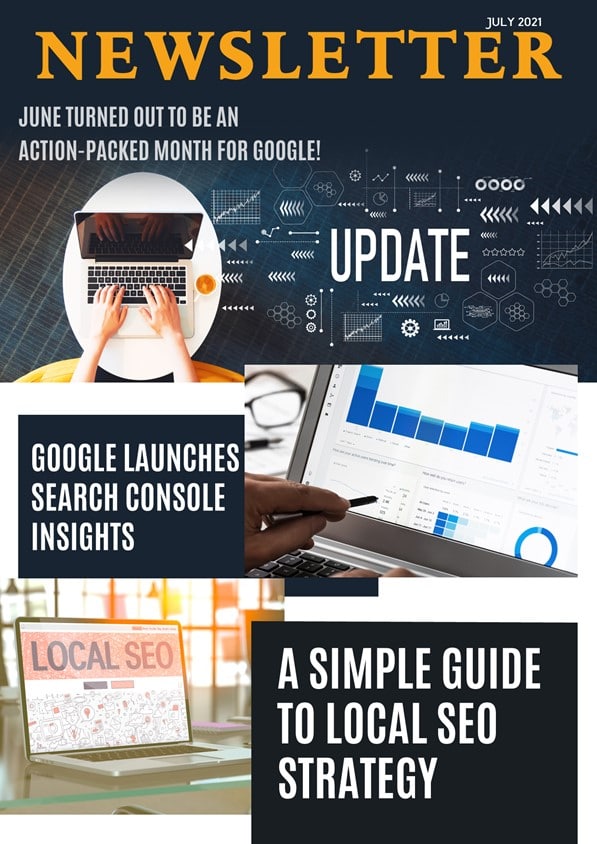




The month of June saw SEOs scrambling to keep up with a number of updates rolled out by Google, namely core, page experience, and spam updates. These updates also had the SEOs scratching their heads, trying to figure out the exact cause of the change in rankings.
While the rolling out of the core update finished on the 12th of June, Google started rolling out the page experience update right on its heels, on the 15th of June. This roll-out is expected to go on right until the end of August. Also, Google went on to roll out a two-part spam update – part one of the update began on the 23rd of June, and part two began on the 28th of June.
What These Updates Signify
The page experience update has a lot to do with HTTPS and metrics such as the speed, responsiveness, and core web vitals. If you wish to see how this update may affect your site, the updated layout is live in all the testing tools and Google Search Console. However, you need to bear in mind that the Search Console data is delayed, as it is based on the CrUX (Chrome UX Report) data aggregated over the past 28 days.
As this roll-out is going to last months, chances are you may not see any drastic shift in a site’s visibility. This should give you the time to work on your site’s metrics so that its performance meets your expectations.
Unlike core and page experience updates, spam updates begin and end on the same day, which means your website rankings may be impacted almost immediately. Hence, if a website saw any changes in rankings on the days when this two-part update rolled out, you know what may have caused it.
That said, none of our websites experienced any major shift in rankings.
Final Takeaway
Although there is a great deal of talk around these updates, it is still too early to know exactly how they will affect site rankings. As for the spam updates, the SEOs do not seem to be too impressed and feel that too many spam sites are still being ranked.
When it comes to core updates, here’s a look at all a site owner should know about Google’s core updates. Also, if you would like some more information on the page experience update that is still rolling out, keep an eye out for the updates posted on the Page Experience Blog and the Core Web Vitals & Page Experience FAQs.
Analyze your site?

Last month Google Search Central announced via Twitter “a new experience” called Search Console Insights “to help you better understand which content of yours resonates with your audiences.”
According to Google –
“This experience joins data from both Search Console and Google Analytics with a goal of making it easy to understand your content’s performance. Whether you are a web content creator, blogger, or a website owner, and independent of your technical expertise, it can provide you with an overview and helpful insights on how your content is performing.”

This experience will help you answer certain sample questions listed by Google.
- What are your best-performing pieces of content, and which ones are trending?
- How do people discover your content across the web?
- What do people search for on Google before they visit your content?
- Which article refers users to your website and content?
At present, you can access Search Console Insights in a couple of ways:
- Select Search Console Insights from the top of Search Console’s Overview page.
- Access it directly and save a bookmark.
- You will “soon” be able to access it in the iOS Google App by selecting Search Console Insights in the account menu. Google went on to say that they are “working to also add Android Google App support.”

What Actions To Take
Search Console and Google Analytics give a great amount of information, but if you do not have the time to regularly go through everything, it can be a bit too much. Search Console Insights filter this information, giving you a brief overview of the updates related to your site.
When it comes to SEO agencies, Search Console Insights will come in handy to help less savvy site owners see how your work is benefiting their site. This also means that you can use Search Console Insights even if you do not use Google Analytics.
To get complete insights about your content, Google suggests linking your Google Analytics property with your relevant Search Console property.
Queries, if any, can be directed to one of Google’s support channels and also at @WebCreators on Twitter or @GoogleWebCreators on Instagram.
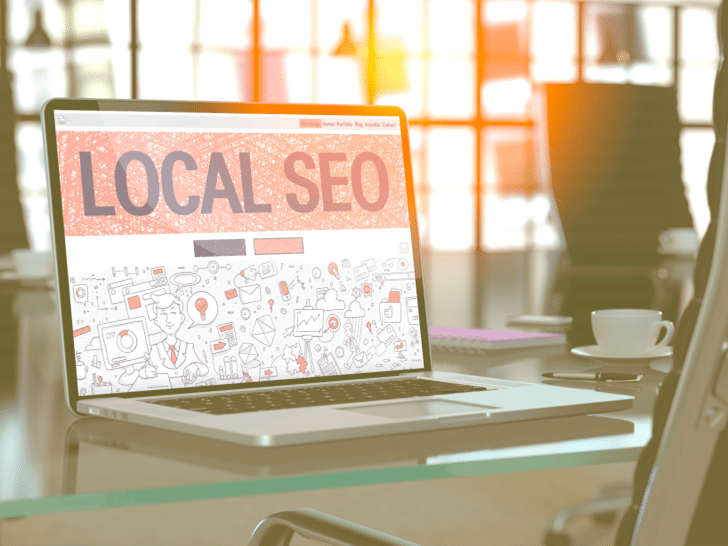
Have a business that serves a specific location? It is important to develop an SEO strategy that can help you target local customers and rank higher in Google search. While all businesses can benefit from search engine optimization, certain industries, like Professional Service Industry (banks, accountants, attorneys, financial planners, and many others), Home Repair & Renovation Service Industry, Medical Industry, Restaurant and Food Service Industry, etc., can benefit more.
Let’s take a look at some important benefits that Local SEO offers for small as well as large businesses.
- SEO puts you up higher on Google’s search result pages and helps you get more traffic to your site.
- Other local businesses can find you easily to create a coordinated marketing campaign that can benefit both.
- SEO helps you get positive reviews, rank higher, and earn more trust.
- You can save on advertising costs if your business is sufficiently high in the rankings.
- Your business can appear in local business directories.
- Voice searchers can find your business easily.
The above-mentioned benefits give a clear answer to your question ‘why my business needs SEO?’. Let’s now understand how to create a local SEO strategy for any business.
Follow the steps given below:
- Prepare a list of keywords related to your business. For example, if you run a restaurant, your keywords can be Mexican Food, Chinese Food, etc.
- Perform an SEO audit on your site to identify any existing technical issues. If you are already aware of any issues, address them first.
- Conduct a competitive analysis using SEO tools to find out what keywords your competitors are ranking for. This analysis will help you determine which keywords are a perfect fit for your site.
- Add your location to the keywords and perform an SEO analysis to find out the search volume and keyword variations of Geo-specific Keywords (example: Mexican Food Seattle, best Mexican Food Seattle, etc.).
- Follow on-page SEO best practices to optimize your site for local search. On-page optimization would include –
- Keyword mapping of individual site pages
- Unique & relevant title and description for each page
- Informative content about your products & services
- Relevant internal links on your site pages
- Images that are appropriate & compressed
- Short & targeted URL structure
- Localized landing pages can help you get more organic searches. To create perfect landing pages, you must optimize your page headings, include keywords in page content, etc.
- Create your GMB account, and be sure to add the correct business address, contact number, images, and other details.
- List your business with other online directories to gain more customers.
- Create a Link Building Strategy to increase the ranking of your site.
- Try to generate positive reviews across the directories your business is listed in. Also, respond to negative reviews in a professional & kind manner.
Are you getting the best return out of your digital marketing?
Need an extra pair of eyes to review your online game plan? Let our experts take a look at your current state and do a comprehensive digital marketing analysis at no cost to you. Please call us at (800) 379-2829 or contact us today and we will get to work right away.