You’ve likely heard of search engine optimization (SEO) if you’re a business owner or marketer. But did you know that SEO is more than just a buzzword? It’s the key to unlocking the full potential of your website and driving organic traffic to your online presence. Why? Research shows nearly 70% of all trackable website traffic starts with organic and paid search results on a search engine. Moreover, over 90% of searches begin on Google.
In this comprehensive guide, we’ll dive into the secrets of SEO and provide actionable tips to help you rank #1 on Google.
SEO means enhancing your website’s visibility in search engine results pages (SERPs). This requires improving your site’s accessibility, user-friendliness, and relevance to your intended audience. To begin with, let’s learn the fundamentals of search engine optimization before we move on to our tips.
When it comes to ranking factors, Google considers more than 200 of them. Some of the most important ones include:
Creating high-quality, engaging, and informative content is crucial for improving your website’s search engine rankings. Google rewards sites that provide value to users and keep them engaged.
Identifying and targeting relevant keywords is essential for attracting the right audience to your website. Keywords should be carefully chosen based on your target audience’s search queries and integrated naturally into your content.
It is essential to offer visitors a smooth and pleasant experience while browsing your website to keep them engaged and motivate them to explore further. Google rewards websites that provide a positive user experience, while sites that are difficult to navigate or slow to load will receive lower rankings.
High-quality backlinks from reputable websites indicate to Google that your content is reliable and valuable. Building a robust backlink profile can significantly enhance your search engine rankings.
Optimizing your site’s performance can significantly improve its visibility in SERPs. Having fast-loading pages is very important for user experience and search engine rankings. If pages load slowly, people are more likely to leave the site, which can result in a decrease in search result rankings.
With these factors in mind, let’s explore how you can optimize your website and climb the ranks on Google.
Your plan to improve search engine optimization involves gathering information on relevant terms—keyword research. The process helps you identify the terms and phrases your target audience uses when searching for products or services like yours. To perform keyword research, consider the following steps:
- Brainstorm: List down topics relevant to your business.
- Research: Use keyword tools like Google Keyword Planner, SEMrush, or Ahrefs to find popular keywords related to your topics. (These services can be costly, complex, and timely to learn and use)
- Analyze: Evaluate keyword competition and search volume.
- Select: Choose the most relevant and attainable keywords for your website.
Remember to focus on long-tail keywords (phrases with three or more words), which tend to have less competition and higher conversion rates. However, when performing keyword research, remember that relevancy is equally essential to search volume.
Create High-Quality Content
High-quality and engaging content is crucial for improving your website’s SEO. Google rewards websites that offer valuable and informative content to users. To create high-quality content:
- Write for your audience, not search engines
- Focus on topics that answer user questions or solve their problems
- Use your target keywords naturally throughout your content
- Include multimedia elements like images, videos, and infographics
- Break up text with subheadings, bullet points, and short paragraphs
The more content you create, the better your chance of ranking for multiple keywords. However, remember the key is quality over quantity. With great content, you can build trust and loyalty with your audience.
Optimize On-Page Elements
The process of on-page SEO aims to improve the rank of individual web pages in search results. Key on-page elements to optimize include:
Create unique, descriptive titles that include your target keyword. This step helps search engines understand the content of your page and improves its visibility in search results.
Write compelling, keyword-rich summaries of your page content. A well-crafted meta description can entice users to click on your link and increase your click-through rate (CTR).
Keep them short, descriptive, and include your target keyword. Clean and easy-to-read URLs make it simpler for users and search engines to understand the purpose of your page.
Use H1, H2, and H3 tags to structure your content and include keywords. Adequately structured content with relevant header tags improves readability and makes it easier for search engines to crawl and index your site.
Describe the content of your images using relevant keywords. This helps search engines better understand the context of your images and can improve your site’s accessibility for visually impaired users.
Optimizing these essential on-page elements can improve your website’s search engine visibility and increase organic traffic.
Backlinks are links from other websites directing visitors to your site. They act as votes of confidence, signaling to Google that your content is authoritative. To build quality backlinks:
- Create shareable, link-worthy content
- Reach out to industry influencers and bloggers for guest posting opportunities
- Engage in online communities related to your niche
- Use social media to promote your content and encourage sharing
Improve User Experience (UX)
A positive user experience is crucial for SEO success. Google rewards websites that provide a seamless, enjoyable experience for visitors. To improve UX:
- Implement a mobile-friendly design
- Increase your website’s loading speed
- Use clear, intuitive navigation menus
- Ensure your site is free of broken links and errors
Finally, tracking your SEO progress is essential by using tools like Google Analytics, Google Search Console, or third-party platforms like Moz or SEMrush. By monitoring your website’s performance, you can identify areas for improvement and adjust your strategy accordingly.



Thanks to a study that was earlier published by Sterlingsky, we learned that if a local listing manages to garner 10 reviews or more, they get a ranking boost in the Local Search Results by Google. The study also shed light on the fact that the recency and length of the reviews play an important role.
Last month, we saw the results of another study being published! This new study suggests that reviews with more than one upvote tend to stay in the top ten for around 100 more days as compared to those with one or no upvote.
Take a look at the chart below that clearly indicates the more upvotes a review gets, the longer it stays in the top ten.

Considering the fact that a previous study conducted in 2021 reported that the upvotes play no role in moving a review up in position, the findings of the latest study have surprised many.
Why This Is Important?
Having useful reviews appear in the top ten is bound to be more beneficial not only for your business but also for your customers. Hence, it is recommended that while asking your customers to leave a review, you also ask them to upvote the helpful reviews they find on your listing.
Are you interested in repairing your online reputation to increase your review quantity? Contact us to see how eBizUnvierse can improve your online reputation.
According to Google, links may become less important in the future. But a recent survey contradicts Google’s prediction. The survey says that links continue to be a critical ranking factor.
The survey anonymously asked 755 professional link builders about how they build links, what works best / worst for them, and what it really takes to make link building work for their business.
Here’s a summary of the most interesting findings and key statistics:
- 3% of link builders pay for links. We knew this number would be high, but didn’t expect it to be this high.
- We broke down the specific amount being paid and found that the average cost of a paid link is $83.
- However, when comparing those who pay for links VS those who don’t, we found that paying for links yields only an extra 2 links per month.
- In-house SEOs pay 75% more for links than niche site owners. Nobody seems to have a problem spending other people’s money.
- Looking at all links, when salaries are factored in, we found that experienced link builders can build links 41% cheaper.
- It takes an average of 3.1 months to see the impact of a link on the search ranking, with very few saying it takes longer than 6 months or less than 1 month.
- Guest posting is, by far, the most popular link-building tactic. It is somewhat contradictory to the point that the same people said creating content or linkable assets is the most effective link-building tactic.
- Google has told us that nofollow is a hint, not a rule. Our participants agreed, as 89.1% of link builders say nofollow links have an impact on rankings.
- Looking for a way to boost your results? Are you using social media for outreach? Link builders using social media build 22% more links than those who don’t.
This survey was published in November 2022, just before Google’s Link Spam Update. This update specifically targeted purchased links, showing that Google still considers links to be an important part of its ranking algorithm.
However, there is a possibility that Google is overestimating its ability to detect purchased links. Only time will tell if buying links is still a viable ranking strategy. So, for now, be careful and stay tuned for updates.
Are you having trouble keeping up with all the Google SEO updates recently? Contact us and see how we can help you maintain your high ranking without sacrificing your time.
There is a question that is being discussed all over the world now: Can ChatGPT answer all of our questions in the way we want? And if it can, will it revolutionize how we search for and ask for things on search engines? Well, you may wonder, discuss, or throw your opinions straightaway, but Microsoft is bringing ChatGPT’s AI question-and-answer service to its Bing Search, opening a whole new world of possibilities for us to interact with AI in everyday life.
This chatbot, launched by OpenAI, has become incredibly popular across the globe. Everyone, not just professionals, is using it for their projects, research, homework, writing essays, and getting answers to their queries. Some people loved it so much that they called it the “Google killer!” So, is it a code-red for Google, or are we going too far? Let’s find out.
Launched in November 2022, ChatGPT is based on OpenAI’s GPT-3.5 family of large language models and has been refined through supervised, reinforcement learning techniques. It can teach itself how to answer questions by using content drawn from the web that dates up to 2021. However, it has difficulty keeping up with recent and popular topics!
Keeping all that in mind, Microsoft is planning to launch a version of its Bing search engine that uses the artificial intelligence behind ChatGPT to answer search queries instead of simply providing a list of links. This feature will depict a human-like interaction, which Microsoft thinks will help it outflank Google.
So is it really a “Call the ambulance!” moment for Google? Well, experts in the industry are saying no. Google already has advanced AI and machine learning that can do the same as ChatGPT or even better. And to add to this, it has ways to detect AI-generated plagiarism and scraped content. In conclusion, it’s a “Call the ambulance, but not for me!” from Google’s side.
Are you getting the best return out of your digital marketing?
Need an extra pair of eyes to review your online game plan? Let our experts take a look at your current state and do a comprehensive
digital marketing analysis at no cost to you. Please call us at
(800) 379-2829 or
contact us today and we will get to work right away.



You might be wondering how this is possible. You are doing just fine with AI tools and even progressing in your business. They write for you, act as your virtual assistant, and pretty much help you with everything. But there’s also a shadier side to it. Last month, Google rolled out a spam update in which it targeted websites that have content generated by AI. It affected AI pages that were poorly done and their rankings on search results, leaving an overall negative impact on businesses online.
The following are the global categories that have suffered the most damage:

(Source: NeilPatel.com)
As you can see from the chart, news and sports sites were hit the hardest. Arts and entertainment were close behind, and communities also made the top five.
Most of these sites were content-based rather than product-based.
Google’s spam update was based on mainly 3 elements:
Content
To get more search links and traffic, sites have content on their pages that provide little or no valuable information to users. These are thin-content scraper sites created by AI.
Meta tags and descriptions
Every business wants to appear on the first page of search engine results. And to do so, they allow their meta tags to be repetitive and poorly written, targeting them only for search engines. They forget that they are operating for humans and not search engines.
Keywords
The best way to turn a user into a customer is by providing him with the precise and valuable information he is searching for. But it doesn’t mean that you ruin his reading experience by stuffing your content with keywords to make it more relevant. It will shoo him away.
Google had kept all of this in mind and targeted such websites that were heavily dependent on AI for their content.
However, you must know that not all AI pages were affected. AI content that was modified by humans fared way better.
To give you a summary, here’s a chart for you:

(Source: NeilPatel.com)
This means the more “human-generated” content you have, the better your business will do.
So what do you do now? How do you check if your content is authentic and valuable to your potential customers? How do you still use AI tools for content without causing damage to your website’s search rank and traffic?
Google has provided some actionable advice to prevent such damage.
Take the front seat in a content generation:
If you’re using AI to generate content, don’t rely on it completely! Instead, modify your content. Your brand has its own voice; adjust the tone to match it. Don’t run after keywords; provide value in your information.
Get help from Google:
Google has invited users to learn more about its AI-based spam prevention system, SpamBrain. If your site’s rankings drop, review Google’s spam policies and ensure your web pages are compliant.
Final takeaway
While it is established that AI is beneficial to your business, relying completely on it is not. Let it help you, but have your own control. Consult with digital marketing firms to build your online presence in a reliable way. And most importantly, stay updated in this ever-changing environment!
It can be hard to transition back and rebuild your online presence. That’s why we’re here to help, contact us.
With the increasing popularity of mobile searches, Google has announced a new update. Google recently announced that it will be introducing site names on mobile searches. It says that site names are currently available for mobile Google Search results in English, French, Japanese, and German. Over the next few months, they will be rolling out additional languages.
New Site Name Structured Data Documentation
Google has several sources to identify the site name for a search result; you can use structured data on your homepage to indicate your preferred site name and let Google know what the site name should be.
According to Google,
When Google lists a page in search results, it shows the name of the site the page comes from. It is called the site name. Google uses several different sources to determine the site name, and you can indicate your preference by adding WebSite structured data. Note that the site name is different from the per-page title links (title links are specific to each web page, whereas the site name is for the entire site).
Site names can appear in English, French, Japanese, and German for mobile Google Search results. You can learn everything you need to know by studying Google’s developer doc, which provides details on each of the following topics.
- How site names in Google Search are created
- How to add structured data
- Guidelines
- Structured data type definitions
- Troubleshooting common issues
- Troubleshooting structured data issues
Also — Google recommends revisiting the documentation for favicons. Since they intend to continue showing favicons on Search, they also recommend providing an icon that’s at least 48px and following the existing favicon guidelines.
See How You Can Improve Your SEO!
In order to combat review manipulation on Google Maps, two new restrictions have been put in place. These should help to create a more level playing field for businesses and give users a better idea of what to expect when they visit a place.
In Google’s Prohibited and restricted content support document, you’ll find a Deceptive Content section that talks about Fake Engagement, Impersonation, Misinformation, and Misrepresentation. The new restrictions are included under the Fake Engagement point. Here’s a screenshot of the same below.

So we can conclude that only genuine reviews are encouraged, and if anyone tries to violate these restrictions, they can be penalized.
Are you getting the best return out of your digital marketing?
Need an extra pair of eyes to review your online game plan? Let our experts take a look at your current state and do a comprehensive
digital marketing analysis at no cost to you. Please call us at
(800) 379-2829 or
contact us today and we will get to work right away.



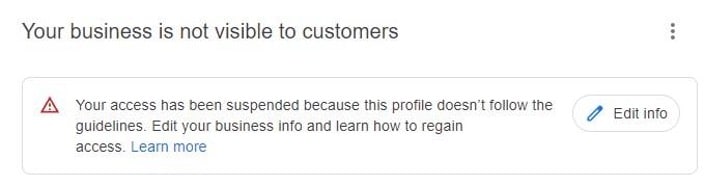
If you receive this message from Google, “Your business profile on Google has been unfortunately suspended, and the reason for the suspension normally is only “due to quality issues” or “suspicious activity”, if you are on Google Business Profile Manager, or “this profile doesn’t follow the guidelines” if you are on Google Search Dashboard,” Google has suspended your account.
Let’s know more about the “Suspended” alert messages from Google and the most common reasons for a profile suspension.
Main Suspended Messages from Google:
Suspended for suspicious activity:
- “Your listing has been suspended because it was flagged for suspicious activity”
- “This location has been suspended because it was flagged for suspicious activity”
- or “Your Business profile on Google has been suspended because it was flagged for suspicious activity”
Suspended due to quality issues:
- “Your listing has been suspended due to quality issues”
- “This location has been suspended due to quality issues”
- “Your profile has been suspended due to quality issues”

Suspended because this profile doesn’t follow the guidelines:
- “Your business is not visible” followed by “Your access has been suspended because this profile doesn’t follow the guidelines. Edit your business info and learn how to regain access”
Want to know what that means?
Your Business Profile Listing has been suspended because it was flagged for suspicious activity.
Why was your Google Business Profile flagged for suspicious activity?
Normally this type of suspension is due to:
Certain Profile Edits (Business name, Address, Service Area Business, Phone number, Category)
Several edits were made in one single section, and it does not matter which edits were
The owner’s Google Account was suspended
Your Business Profile Listing has been suspended due to quality issues or doesn’t follow the guidelines.
Why was your Google Business Profile suspended due to quality issues?
Normally, this type of suspension is due to:
- Google Algorithm signalized issues with your profile, most of the time because:
- Finds conflicting information about your business on the web (directories, Social Networks, your website)
- Identifies your address as a residential address, co-working space, PO Box, UPS Store, Virtual address
- Found duplicates (How to find and remove duplicates)
- User(s) reported the listing on Google through the “Suggest an edit” feature – Algorithm suspension if it thinks reporting is justified
- User(s) reported through redressal form – Manual suspension by a Support Agent
Here are the Main Reasons That Get Your Google Business Profile Suspended:
- Keyword stuffing your business name.
- Using a P.O. Box or UPS store address.
- You set up your listing at a virtual office or co-working space address.
- You have a service-area business and are displaying a physical address.
- You have an online-only business.
- You are in a high-risk business category, like lawyers, plumbers, HVAC, locksmiths, rehab centers, etc.
- If another business shares the same address.
- You have made a bunch of changes/edits to your GMB profile in one sitting.
- The URL you add to your GMB profile forwards/redirects to another website or links to a social media page.
- If you change your listing from a Storefront to a Service Area Business (SAB).
- Your address or hours don’t match what is listed on your website or other online business directories/citations.
- You list your business hours as 24/7.
- An owner user (sometimes a manager) on your profile got their Account suspended – so your listing got suspended because they got suspended.
- You created multiple listings for the same business at the same address (duplicate listings).
- Photos, Posts, Services, and Business descriptions are spammy or against Google’s policies.
The thing you need to worry about is Google doesn’t tell you the reasons why your business account was suspended.
Yes, Google doesn’t tell the business owners about the reasons why their profile was suspended. Even if you contact support asking for the reasons, they just tell you to go through the guidelines and try to figure out by yourself the why.
Google’s advice on how to resolve the business profile suspension issue
Google Business Profile’s support article only advises:
- Review the Google Business Profile guidelines.
- Ensure your profile follows the guidelines.
- After your profile meets the guidelines, you can ask for reinstatement

And if it is denied, you can appeal; but it does not tell you how.
Note: Even though the reinstatement process can be very frustrating, please note you should never: remove the profile from the dashboard (you will lose all the reviews); create a new profile (high chances of getting suspended, even if Google support tells you to do it); or submit multiple reinstatements yourself (will only delay your case).
Is your listing suspended? Get in touch with our team to get it unsuspended!
Many business owners and SEO experts had a baffling afternoon on 23rd September, Friday. The reason being the roll out of a fix for the bug that caused a number of businesses to experience a drop in local rankings in the last month.
A local search expert uploaded a post on Twitter about this.

Referred to as the “Kansas” bug, it has been dropping some service area businesses in the middle of the USA — in Independence, Kansas in Google Maps / Google My Business.
However, thanks to the recent fix rolled out by Google, some of the businesses have recovered their local rankings, albeit not as they were before the shakeup.
Why this matters — It’s always nice to know it wasn’t you when it was them.
See How You Can Improve Your SEO!
Your meta descriptions are important for your website’s SEO. Make sure they are clear and concise so potential viewers will be able to get a good idea of what your page is about before clicking through to it. In addition, high-quality descriptions can be displayed on SERPs, and can also help improve the quality & quantity of your website’s search traffic.
Let’s dive into some examples to get better at writing meta descriptions
| DETAILS INCLUDED |
BAD WAY OF WRITING |
GOOD WAY OF WRITING |
| Keywords |
- <meta name=”description” content=”Sewing supplies, yarn, colored pencils, sewing machines, threads, bobbins, needles”>
|
- <meta name=”description” content=”Get everything you need to sew your next garment. Open Monday-Friday 8-5pm, located in the Fashion District.”>
- Explains what the shop sells and details like opening hours and location
|
| Description for articles |
- <meta name=”description” content=”Local news in Whoville, delivered to your doorstep. Find out what happened today.”>
- Same description used for every news article
|
- <meta name=”description” content=”Upsetting the small town of Whoville, a local elderly man steals everyone’s presents the night before an important event. Stay tuned for live updates on the matter.”>
- Uses a snippet from the specific news article
|
| Summary of the page |
- <meta name=”description” content=”Eggs are a source of joy in everyone’s life. When I was a small child, I remember picking eggs from the hen house and bringing them to the kitchen. Those were the days.”>
- Doesn’t summarize the page
|
- <meta name=”description” content=”Learn how to cook eggs with this complete guide in 1 hour or less. We cover all the methods, including over-easy, sunny side up, boiled, and poached.”>
- Summarizes the whole page
|
| Length of the description |
- <meta name=”description” content=”Mechanical pencil”>
|
- <meta name=”description” content=”Self-sharpening mechanical pencil that autocorrects your penmanship. Includes 2B auto-replenishing lead. Available in both Vintage Pink and Schoolbus Yellow. Order 50+ pencils, get free shipping.”>
|
Lastly, your descriptions should be easy for people to read and understand and should also be diverse, so potential customers can get a good sense of what your product or service can offer them.
Are you getting the best return out of your digital marketing?
Need an extra pair of eyes to review your online game plan? Let our experts take a look at your current state and do a comprehensive digital marketing analysis at no cost to you. Please call us at (800) 379-2829 or contact us today and we will get to work right away.
In this day and age, it has become very important for SaaS businesses to invest in search engine optimization. To attract higher traffic and boost visibility, you need to improve the ranking of the website in search engine result pages. With on-page and off-page SEO, it becomes easier to achieve all the business goals in a given time. If you think about it, there is a lot of competition in the SaaS business industry. SEO is how you can stand out in the market and gain an edge over your competitors as well.
For a SaaS website, the strategy for optimization is slightly more technical. Other than the keywords, you should also focus on curating the website content carefully and building quality links as well. These are just the basic factors that can get you started. When it comes to SaaS technical SEO, the structure of the website and visual hierarchy are highly important too. To make this easier for you to understand, here are some important cases from practice.
Prioritize User Experience
One of the most important factors in SaaS SEO is user experience. When the website is considered by a search engine’s algorithm, this is at the top of the list. Google for instance will rank pages that have good quality links and simple navigation higher than many others in their search results. You also need to pay attention to the sitemap and organization of the website which makes it easier to browse through for visitors.
Drift is a case that you can study as an inspiration here. The chatbot service attracts a wide audience for its authoritative content and internal linking. Visitors can find all the relevant information within seconds and look through all the articles on chatbots and how they work. Its structure allows the crawlers for Google to understand what the business has to offer to its customers quickly.
When you are working on the search engine optimization strategy for your SaaS website, make sure that you keep these factors in mind. Prepare the brand visual elements beforehand so the pages are easier to organize and link. Get the logos for the website and other digital mediums, in the beginning, to simplify the layout for a higher ranking in SERPs.
Valuable Product-Focused Content
This is another thing that you need to keep in mind for SaaS technical SEO. The content available on your website should be high-quality and valuable for the product. If you take the case of Notion, you will see how the platform has improved its visibility by producing blog posts and insights that connect to the product. With attractive visuals and GIFs, these posts focus on the features of Notion and how each one can help solve a problem for the audience.
The posts on their blog and website convince visitors to try their products or sign up for more information. This way, the businesses manage to convert a high number of leads and reach out to cold ones as well. It is a good example of product-focused content that can boost the ranking of a website in search results. Google’s algorithm and crawlers look for insights and articles that create recognition and awareness.
If the blog posts or visual content is generating the desired results, you can easily find your SaaS website on the first page of search results.
It is not just about using the popular phrases or keywords that people search for. When it comes to SaaS technical SEO, you should go beyond on-page optimization. Anyone searching for products for a certain location should be able to find your website. For example, a site for Chicago should engage a Chicaco SEO agency to optimize all the essentials for you. AIt is a good idea to add short-form content that answers commonly asked questions about the brand or industry. You can use popular social media networks to research questions and include the answers in the website content. Take the case of Zapier as an inspiration here.
The website has a help center that almost works as a search engine. Visitors can browse through the articles to understand the product or ask any questions that might be confusing them. The help answer allows the website to appear in the top results as people find the solutions highly useful. For your website, you can also create an FAQ section for different landing pages or a centralized support section.
This can boost the visibility of your website and help improve user experience as well. In the long run, it’s also a good way to build a loyal customer base.
These are some of the practice cases for SaaS technical SEO. If you are looking for strategies to improve the ranking of your business website in search results, you can take inspiration from the examples or cases given above.




In August, Google announced a new big search ranking algorithm update, named the helpful content update – probably its biggest update in a decade.
What We Know
The helpful content update will target websites with a relatively high amount of unsatisfying or unhelpful content, where the content has been written explicitly for search engines to leverage rankings.
Unlike many Google algorithms that get applied page-by-page, this new helpful content update will be sitewide. That means that if Google determines your site is producing a relatively high amount of unhelpful content, it will impact your whole site.
This reminds us of the early Panda and Penguin update days. Just as a quick reminder – or in case you weren’t working in SEO a decade ago – those updates did a lot of damage back then, and we made significant changes to our SEO strategies to recover and protect our client websites.
Which Sites Were Likely Impacted?
According to Google, this update impacted these types of content the most:
- Online educational materials.
- Arts and entertainment.
- Tech-related.
This is because content written in those areas has historically been written more for search engines than humans.
These are the folks that were hit the hardest:
- Publishers focused on a broad range of topics like CNET, Forbes, etc.
- Sites that collect and monetize organic search traffic without providing unique value.
- Sites that have content created with AI tools like Jasper or Copymatic.
- Sites with SEO doorway pages created for the sole purpose of boosting rankings.
- Sites with spammy content with a very high keyword density.
Our Observations:
We were quick to run a deep ranking audit of more than 3.5K websites, and we are happy to inform you that so far, this update did not have any significant negative impact on our client’s websites. In fact, we have seen good improvement in positions for the sites we are working on. This implies that our content strategy, in conjunction with our other SEO efforts like on-page optimization and link building, is working well and protecting our client’s websites.
Are your GBP posts getting rejected? Well, that’s because GBP has added more restrictions to its list of guidelines. As stated in their support document under the “Avoid Spam” header, Google warns business owners to avoid uploading duplicate photos, posts, videos, or logos.
Here’s a screenshot of the other guidelines that you should know.

So, using original images & relevant content is the only way to get your posts accepted.
Need help? Get in touch with our technical support team for assistance.
Recently, it has been discovered that Google Maps is emailing customers who have posted a review for any business when their review is flagged as fake and, therefore, not posted.
It came to light after Lucio Laria – Consultant SEO International raised this issue on the Google Business Profile community. When a help forum titled Legitimate review started getting flagged as “Fake Engagement”, he wrote:
Hello,
I just settled my Google profile and asked my client for a review. Google is filing this review as a fake engagement when this person is a legitimate client of mine.
I’m waiting for this to be fixed before asking other of my clients for their reviews.
Why is this happening, and how can I fix it?
Thanks,
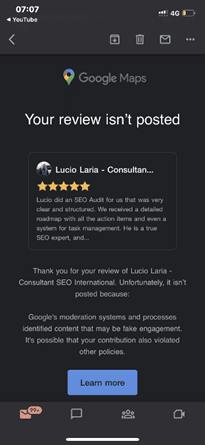
Among the many conjectured reasons and suggestions put forth by knowledgeable forum members are the following:
- It may be related to the review content. See Prohibited and restricted content. Ask the reviewer to delete it and then write a new review.
- It may be due to a problem with the reviewer’s account.
- Because the provider is in France and the client is in Argentina, the distance between them could be the reason.
- Ask the reviewer to try again, leaving a 4-5 sentence review, and add specifics about the services provided and, if pertinent, the location at which they were provided. If that fails, ask them to leave a review from another account.
The reviewer received the email notification about 15 minutes after posting the review. As the forum community pointed out, the review was being “filtered by an algorithm that enforces Google’s content policies”.
Why You Should Pay Attention to This Issue:
As we all know, getting legitimate reviews is not an easy task. It takes a lot of effort to impress a client and even more to convince the client to post a good review. It is disappointing when our sometimes hard-to-get legitimate reviews get taken down for “algorithmic” reasons, as requesting the client to post it again can be a bit awkward.
So, it’s crucial to learn how to get our good reviews to stick the better we can prep our customers and clients to get it right the first time.
Are you getting the best return out of your digital marketing?
Need an extra pair of eyes to review your online game plan? Let our experts take a look at your current state and do a comprehensive
digital marketing analysis at no cost to you. Please call us at
(800) 379-2829 or
contact us today and we will get to work right away.




Google updates its algorithm frequently. At times, they announce the major updates beforehand, and at times they inform after initiating one. The last update was rolled out on May 25th, and to learn about such updates, we had to wait for tweets & official answers from the team.
Google thought of improving this process and has created a dedicated Google Search ranking updates page. With the help of this page, you can check all the latest and previous updates easily.

If you wish to learn how Google improves the search engine, there are several articles from Google to help you. Also, its blog page has more information related to the updates. This page is definitely important for all site owners and SEO experts.
Need more details? Reach out to our support team for assistance.
To help businesses grow their eCommerce site, Google developer advocate Alan Kent recently hosted a video that outlines “8 tips” for SEO-optimizing an eCommerce site.
Here are the 8 tips that Alan believes will help you:
Tip 1: Make sure you have the technical basics in place – You need to ensure your URLs and internal links are friendly to crawlers.
Check out Designing a URL structure for E-Commerce Websites on Google Search Central for advice on how to design URLs for your website.
Tip 2: Create content relevant to users at different stages in their shopping journey – To check the breadth and quality of your site, think about likely searches by shoppers at different stages in their shopping journey. Once you have a set of queries, try them out. Does your site come up well-positioned? What about your competitors?
Tip 3: Be sure to mark up your product variant pages correctly – Product variants are when you have multiple colors or sizes of the same product. Informing Google of the relationship between the product pages can help Google better understand your site content.
The URL Inspection tool can also be used to check the status of individual pages.
Tip 4: For sales events that occur regularly, use the same URL across all event occurrences – This can help Google understand and trust the purpose of such pages. To identify problems, check the URL for promotional event pages on your site.
Tip 5: The “performance” of your web pages matters – Performance is important to users as a page that takes too long to load may be abandoned by them. It is also an important Google ranking signal. It can be particularly important if you use the same supplier-provided product description as other sellers online. The PageSpeed Insights report is useful for checking the performance of the web page.
Tip 6: Wait for it – Be patient to see the results. SEO, unfortunately, is a long game. Some ranking signals may take months to change. Worse, there is no guarantee of success. While it may take months to reap the benefits of a content creation strategy, it does not mean there is nothing you can do until then.
Tip 7: Seek professional help for your website – If you have done your best to improve your site but are still not getting the results you want, we’re here to provide expert SEO advice.
Tip 8: It’s all about the user – The ultimate goal for Google Search is to put the best possible content in front of the users. Algorithms change over time, but the ultimate goal does not. It does not mean you should not measure your site’s performance. It is still recommended to use tools such as Google Search Console and Google Analytics to collect data on your site.
Here is just one of our success stories that shows the importance of SEO! Ready to be our next success story?
As known to most SEO experts out there, Google renamed Google My Business to Google Business Profile last year while also rolling out more support for managing a business profile.
Going a step further, the search engine giant has now launched another feature that is bound to give small businesses operating out of homes a reason to be happy.
Google Business Profile now features a toggle that will allow businesses to hide their business address from customers if they wish to do so.

The screenshot above shows the businesses can now toggle ‘Show business address to customers’ on and off.
Why Is This Important?
This recently launched support feature is perfect for entrepreneurs operating virtual businesses that aren’t tied to a physical location. It can also prove to be quite helpful for all those home-based service operators who wish to avoid customers visiting.
Are you getting the best return out of your digital marketing?
Need an extra pair of eyes to review your online game plan? Let our experts take a look at your current state and do a comprehensive
digital marketing analysis at no cost to you. Please call us at
(800) 379-2829 or
contact us today and we will get to work right away.




Local SEO strategy refers to the overarching strategy or process used to optimize your site content and online presence for higher rankings. Local SEO strategy focuses on improving business rankings in local search engine results pages (SERPs).
The difference between traditional SEO and local SEO is local SEO focuses your efforts on attracting customers near your physical location — and getting them through your door, while traditional SEO boosts your visibility on a wider scale.
The main benefit of local SEO is that it lets you take advantage of increased visibility in your immediate area.
How does it work?
Google uses numerous factors when ranking local content, but it predominantly focuses on these three signals:
- Relevance: Does your business listing match the searcher’s intent?
- Distance: How close is your business to the searcher at the time of the search?
- Prominence: Is your business well-known both online and offline?
When a user conducts a search using a location or “near me” and your business listing best matches the query, you’ll appear in Google’s local SEO 3-pack — a listing of the top three local businesses that meet the search criteria.
12 local SEO strategy tips to boost rankings and revenue:
- Optimize your local listings and citations
- Understand your local personas
- Conduct local keyword research
- Earn backlinks from local sources
- Write in-depth, local content
- Optimize your title tags and meta descriptions with local keywords
- Include an internal linking structure for location pages
- Update your website
- Improve your UX
- Post local content on social media
- Earn reviews from happy customers
- Track the results of your local SEO strategy
In true Google fashion, the search engine giant has now come up with an update for its rich results guidelines. These updated guidelines are meant to better align the rich results content with the overall Google merchant guidelines.
The new guidelines deny rich results for products that are widely prohibited and are known to facilitate harm in any way to anyone. For example, products that fall into categories like weapons, fireworks, recreational drugs, tobacco, gambling, etc.
The guidelines now have an additional section
Google rich results content guidelines, which have already come into effect, have been updated to add the following section:
“Don’t mark up content that promotes widely prohibited or regulated goods, services, or information that may facilitate serious and/or immediate or long-term harm to self or others. This includes content related to firearms & weapons, recreational drugs, tobacco & vaping products and gambling-related products.”
The new policy applies to all forms of markup
According to Google, the new guideline policies will apply to rich result markups in all forms, be it star ratings, prices, information regarding a product’s availability or other such factors. This, in turn, will impact the prohibited products’ structured data markup.
How does this affect your business?
If you are into the business of selling products that fall into any of the above-mentioned prohibited categories, this update definitely applies to you. All you can do right now is remove the structured data markup from your product pages because Google will not show rich results for them.
Although the search engine will not issue any manual action, the removal of rich results in itself will act as a penalty against violating the rich results content guidelines.
For years, Google’s SERPs have been including knowledge panels so users can find the required results quickly. In this article, we’ll discuss how knowledge panels are created and how they work.
Introduction To Knowledge Panels
Knowledge panels/entity boxes are information boxes that appear on Google’s search results page when you search for specific content. The main aim of these boxes is to provide users with the information they need in brief. The content you search for (for example – people, places, organizations, things) should be present in knowledge graphs to appear in knowledge panels.
Only limited categories or entity types (books and book series, educational institutions, government, local shops, companies, events, movies & film series, music groups & albums, and more) are considered for the knowledge graph. Also, only the most relevant or popular entities of every category are included in the knowledge graph.
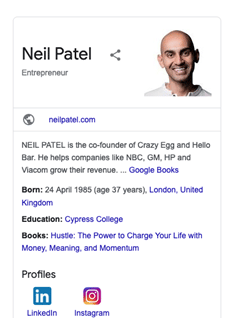
Knowledge panels are different from business boxes, as the latter is based on Google Business. The best way to spot a classic knowledge panel is by looking for a share button in the upper area of the panel. Also, the entity type is specified below the name & depending on the category, various attributes are assigned & the available content is filled.
The image below is an example of a classic knowledge panel. Google prefers using different templates for various entities.
How Are Entities Selected For A Knowledge Panel?
Google has not given any criteria or procedure to select an entity for a specific category. But we have listed some of the most possible ways that Google uses to create a knowledge panel. Several websites that provide semi-structured data, for example – Wikipedia and Soundcloud, can be used by Google to select relevant entities for each category.
How Are Knowledge Panels Created?
In the Google patent, you can learn more about the basic methodology related to knowledge panels. The steps given below describe the basic process followed to create a knowledge panel:
- Finding relevant entities in the query
- Shortlisting relevant sources
- Creating the most appropriate search results
- Cross-checking whether the search query refers to the actual entity
- Determining an entity type/category for the entity requested
- Finalizing a suitable template for the panel (which should match the entity type)
- Arranging relevant content elements for the main entity from a trusted source
- Referring to another trusted source for content elements
- Attaching placeholders in the selected panel template with the finalized content elements
- Merging search results and knowledge panel on one SERP
How Are Images Selected For A Knowledge Panel?
The Google patent describes how images are selected for various entity types and incorporated into the knowledge panel. The steps given below are a shorter version of the same.
- Most relevant images are selected
- Cluster by similarity
- Most popular clusters are identified and separated
- Image format (portrait or not) is determined
- A portrait score is assigned
- The most representative image is selected
- The image is attached to the knowledge panel
The clustering of images into various categories depends on the proximity to the entity as well as the aspect ratio. We can also determine the possible categories by looking at Image Search.

In Google’s patent related to images, the images are labelled with attributes and are assigned to specific entities. These attributes are primarily determined by considering the initial image. Additional attributes can also be added by referring to similar images. It is believed that Google selects relevant images by using data from popular sites (Wikidata, Wikipedia, Wikimedia, social media profiles, magazines, and more).
Reasons Why Knowledge Graph Is Gaining Importance
The SERP features are gaining more importance every year, so it’s expected that the Knowledge Graph will also follow the trend. Since the entities are at the center of the Knowledge Graph, it will definitely affect the rankings and overall search results. To conclude, SEOs should not miss out on the Knowledge Graph when preparing their SEO strategies.
Are you getting the best return out of your digital marketing?
Need an extra pair of eyes to review your online game plan? Let our experts take a look at your current state and do a comprehensive
digital marketing analysis at no cost to you. Please call us at
(800) 379-2829 or
contact us today and we will get to work right away.




As we all know, Google launches core updates at least two to three times a year. These updates cause a hassle to all the web developers and SEO specialists because they have to monitor the rankings and make the required changes.
On May 25th, Google announced an update via a tweet.
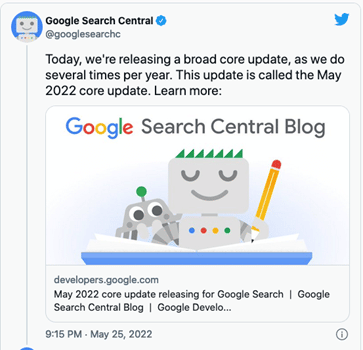
This core update was further explained on Google Search Central. According to this article, Google makes changes to the ranking process to increase the accuracy of the search results. These improvements are called core updates. The core updates are not specific to certain sites but will certainly generate notable effects. Some sites’ ranking may drop, while others may rank better.
Also, Google said that if any site does experience a drop in its ranking, they don’t have to fix anything. These updates are meant to improve the system, helping under-ranked sites to get better traffic.
So, if your ranking suddenly drops, there’s nothing to worry about. You have not violated any webmaster guidelines. You just have to sit back and wait for the next core update. One last thing you can do is observe the sites that have ranked higher and try to figure out the factors that helped them.
Still have any issues? You can get in touch with our experienced team for assistance.
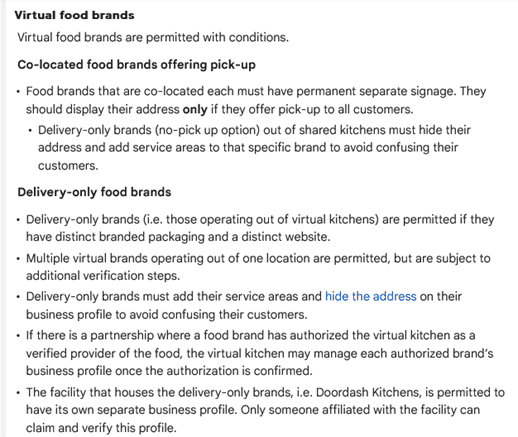
Last month Google laid out new, more specific guidelines to help the virtual food brands and delivery-only businesses with their Business Profiles on Google. These guidelines are meant for food businesses that don’t really have a physical location in an area, but they do re-package and deliver the local restaurants’ food.
The guidelines can be found in Google’s Guidelines for representing your business on Google, under the section Guidelines for chains, departments & individual practitioners.
Here’s a look at what these new guidelines have to say:
Final Takeaway
If you own a virtual food business, it is in your best interest to take a look at the new guidelines so that you can create a business profile on Google that isn’t suspended.
Recently Google’s Dikla Cohen gave a presentation on video indexing, which explains that video indexing does not rely on where and how you host your videos. You can host them yourself or choose from the most popular video hosting platforms and services.
With this, he announced Google is soon launching a new set of reports and tools in Search Console to make video indexing easier to track and diagnose.
With this new launch, the Video Page Indexing report will show a summary of all the pages that Google’s systems find with a video while crawling and indexing your website. At a glance, you can see how many video landing pages were indexed.
Issues will be grouped with a trend line and counts of the affected videos. For example, which videos are missing a thumbnail URL, with reasons – the largest impact ranked on top.
You can click on one of the rows to get more details, such as affected video page URLs. You can also download the list of examples and double-check them. So, you can narrow down the details and understand what is happening and how to resolve issues.
Once your website is updated; and you think you have resolved the issue you were facing, you can go back to the Video Indexing Report, go to that specific issue type, and then use the validate fix button to inform Google.
This way, you can initiate the recrawling of known URLs affected by the issue. And as the pages are being reprocessed, you will be notified if everything is resolved or if there are remaining issues.
But you will have to note that it can take some time to go through all the URLs.
If you wish to check the video indexing status, you can get there by entering the URL of the video landing page at the top of the search console. It will first show you the current status of that URL, as well as the video index status of the page. It will inform you whether Google detects a video on the page. And, if so, did they manage to index it. If a detected video is not indexed, it will list the reasons preventing it from being indexed.
Also, please note that Google indexes only one video per page, even when a page has multiple videos.
To summarize, with the new tools,
- You will be able to see how many video landing pages Google has discovered and how many of them were indexed.
- Examine reasons for unindexed videos on video landing pages.
- You can use the list of affected video page URLs to debug and fix issues.
- You can use the Validate Fix button to initiate recrawling of the known URLs affected by the issue.
- You will be able to check the video indexing status of a specific video using the URL inspection tool.
Are you getting the best return out of your digital marketing?
Need an extra pair of eyes to review your online game plan? Let our experts take a look at your current state and do a comprehensive
digital marketing analysis at no cost to you. Please call us at
(800) 379-2829 or
contact us today and we will get to work right away.




In a new move, Google has announced the use of the AI approach to update the operation hours for over 20 million businesses around the globe in the next six months. Also, Google’s AI algorithms are busy figuring out if your posted business hours are accurate.
Google said, “We developed a machine learning model that automatically identifies if business hours are likely wrong, then instantly updates them with AI-generated predictions.”
How Does It Work?
The AI considers multiple factors, such as:
- The last time you updated your hours
- What they know about other shops’ hours
- The Popular Times information for your shop determined by location trends
Then, the algorithm analyzes the business hours of other similar shops that are nearby, information from the shop’s website, and Street View images of the shop’s storefront. Also, they will look specifically for business hour signs to determine the most accurate business hour prediction.
Google will take the help of the Google Maps community — including Local Guides and even the business owners themselves through their Google Business Profile — to verify the information they have predicted.
What Do You Need To Do?
All the business owners located in Argentina, Australia, Chile, France, Japan, Mexico, New Zealand, Peru, or the United States, should prepare their staff to expect inquiry calls powered by Google’s conversational AI asking about their business hours.
Also, check Google Maps from time to time to ensure that Google has correctly listed the timings, in case they have been changed without your input.
Google performing random display testings are no longer surprising. This time around, it is Google Maps testing the position of local listing previews.
Recently, one of the users noticed that when a specific listing is clicked on from the Google Maps search results that appear on the left-hand side, the local listing pops up in a new position.
Instead of its original position on the left bar, the local listing preview now hovers in a new position, overlayed on top of the map. So far, this new position testing seems to be limited to the Google Maps interface for the desktop.
Here’s a look at the local listing overlay box:

Normally, there would be no overlay box hovering over the map, and the local listing details would appear in the left bar, pushing the search results to the bottom footer.
We have highlighted the main steps involved in setting up an e-commerce site & depending on the work required in each step you can determine the price of the project.
Step One –
- Calculate the time required to set up a WordPress site, install plugins, install a WordPress theme, and meet a client’s requirements.
Step Two –
- Calculate the time you need to finalize images. Mostly, it depends on whether you are –
- Using existing images
- Making new images
- Modifying manufacturer’s images
Step Three –
- Determine the number of products or SKUs included in the project.
- Also, make a note of whether you will take the content from an old site, create your own new content, or reword the manufacturer’s website content.
- Lastly, you need to know if you must create custom category pages and the amount of product information that will be provided.
Step Four –
- Customizing a plugin may need about 20-30 mins, so extra features like Shipping Plugins, Invoicing Plugins, & more should be noted down.
After you have a good idea of the level of work required, you can give an estimated price range for the project. If the estimate is approved by the client, you can charge by the hour to ensure you are paid for your work.
Have any questions? Get in touch with our experts for assistance.
Are you getting the best return out of your digital marketing?
Need an extra pair of eyes to review your online game plan? Let our experts take a look at your current state and do a comprehensive
digital marketing analysis at no cost to you. Please call us at
(800) 379-2829 or
contact us today and we will get to work right away.